Scroll through the scenes or use the chapter links. The sources and version notes follow the story.
When the story or a chapter is focused, use arrow keys to change scenes, Home for the beginning, and End for the ending.
01
Known by her hands
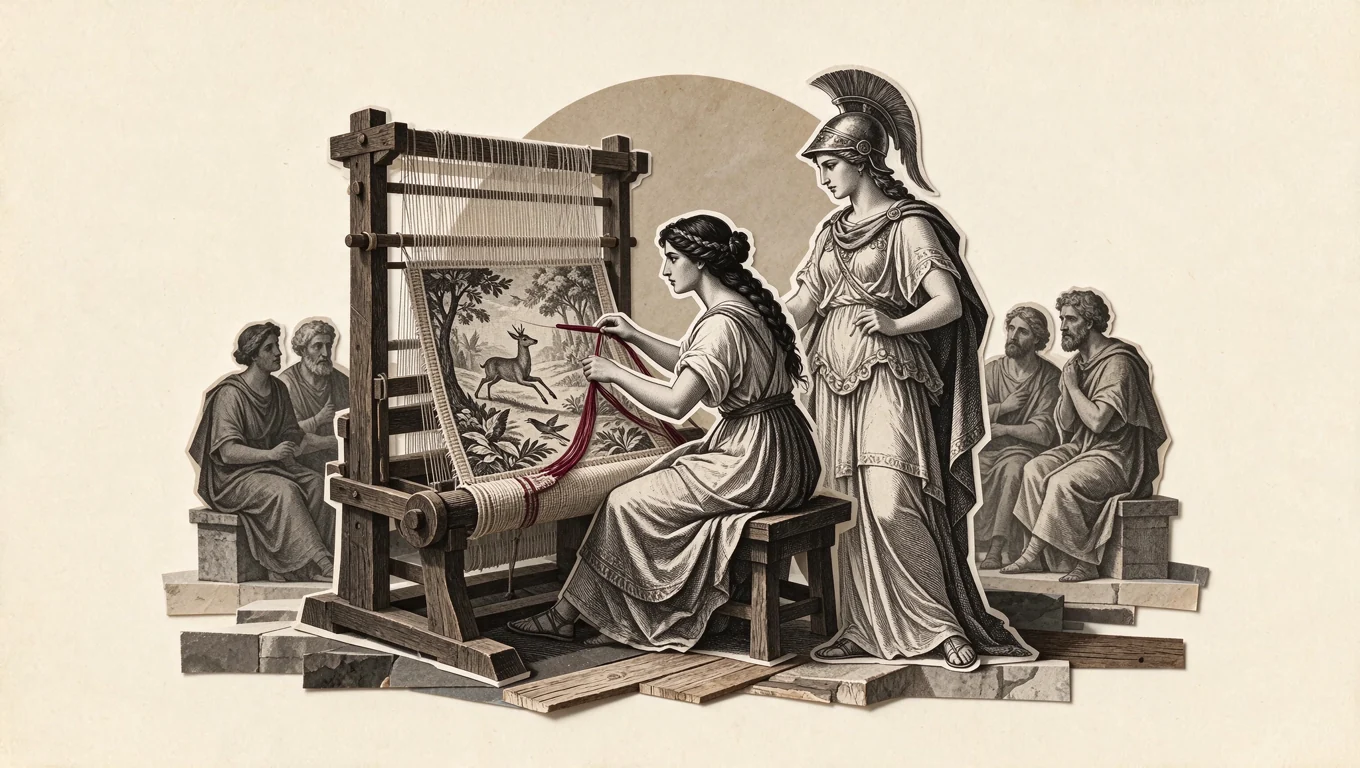
Arachne’s reputation began at the loom. In Ovid’s poem she comes from a modest family in Lydia; her father Idmon dyes wool, and her distinction is her own remarkable work. People travel to watch her, drawn not only by the finished cloth but by the movement of the making. Loose wool becomes thread; thread becomes a pattern; the pattern begins to seem alive. She is not introduced as a queen or a warrior. The attention she commands comes from transforming ordinary material through the repeated, exact decisions of her hands.
Those who admired Arachne’s work might have thought that Minerva herself had taught her. Arachne rejected that explanation. She would not give the goddess credit for the skill by which she had become known, and she was willing to test herself against her. In Ovid’s Roman telling the goddess is Minerva, though readers often know her Greek counterpart as Athena. What begins as praise therefore opens a dispute about authority: whether excellence must acknowledge a divine teacher, and what happens when a human artist refuses the expected answer.
Minerva came in the appearance of an old woman. She offered advice: Arachne could seek the highest reputation among mortals, but should yield to the goddess and ask forgiveness for her challenge. Arachne would not be persuaded. The warning sounded like a demand that the contest be decided before the work existed. She stood by her claim. Then the visitor abandoned her disguise. The goddess was present after all, and the challenge could no longer remain an argument about someone who had not appeared to answer it.
This is Ovid’s Roman literary telling: Minerva is the name on the page, while Athena is a Greek counterpart. Swapping names may be a reasonable adaptation choice, but naming that choice keeps the source and the retelling distinct.
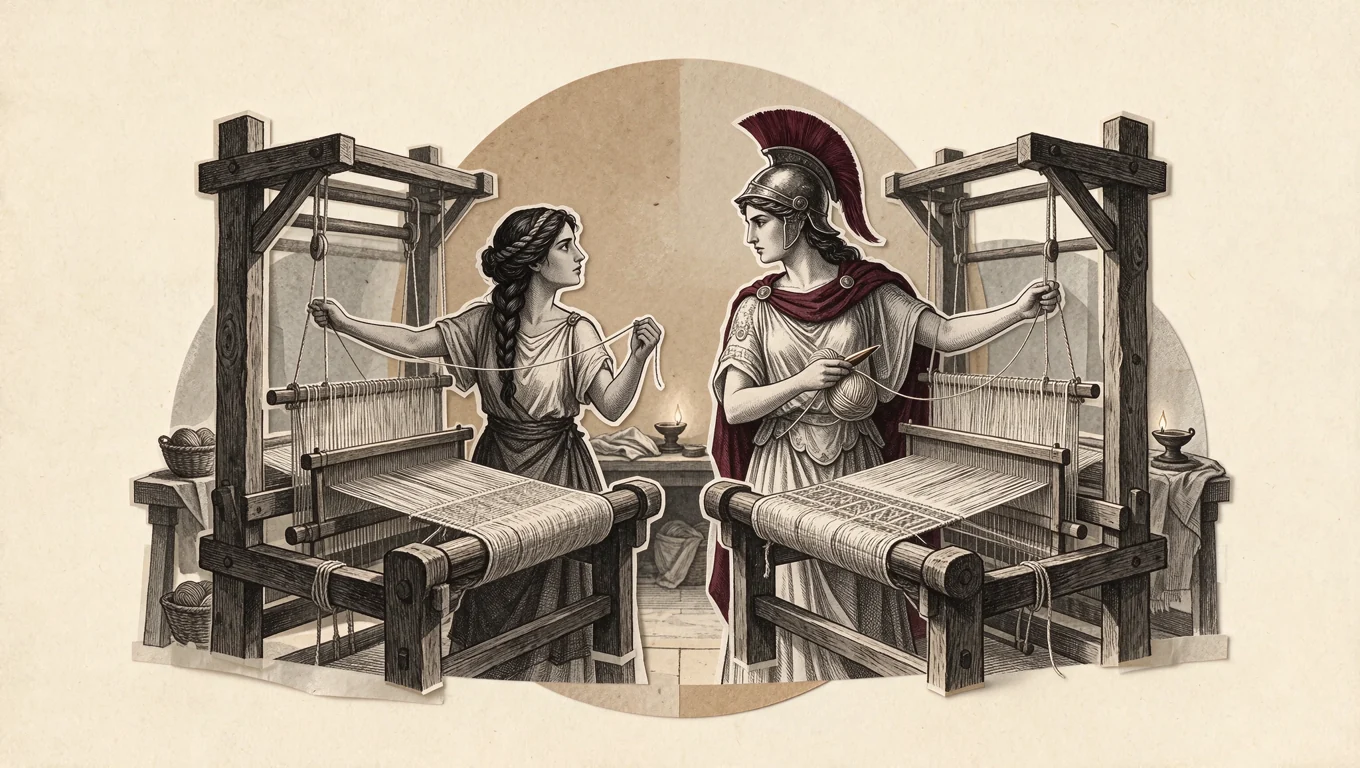
Each took a place at a loom. Ovid lingers over their skilled activity: the stretching of threads, the shuttle passing through, the comb pressing the work together and colours so finely graded that one seems to become another. For a time the shared labour links the opponents. The reader watches two makers rather than a simple division between an accomplished goddess and an incompetent human challenger. The disagreement will become visible through their choice of subjects. Both can make a picture; they are making very different claims about the world pictured in it.
Minerva wove the contest for Athens, showing the gods in their majesty and her own gift of the olive. Around the central scene she placed examples of mortals punished after challenging divine authority. The cloth could be read as a warning directed at the woman sitting opposite her. Its beauty and its message supported one another: the goddess displayed skill while representing a world in which the gods’ honours should be respected. An olive border completed her work. Arachne’s reply would not be another picture of that same order.
Arachne showed gods approaching mortals through disguises and transformations, using their power in acts of deception and harm. Her subjects included Europa carried away by a bull, one of the forms taken by Jupiter. This family telling does not describe the assaults in detail, but it keeps the difference between the tapestries clear. Minerva emphasises the grandeur of divine rule and the consequences of resisting it. Arachne turns attention toward people exposed to divine desire. The challenge is in what the cloth makes visible as much as in how well it has been woven.
Ovid does not resolve the contest by exposing a technical fault in Arachne’s cloth. Notice the difference between a judgement about workmanship and an act of power against an unwelcome picture. The distinction makes the torn work more troubling than a simple failed examination.
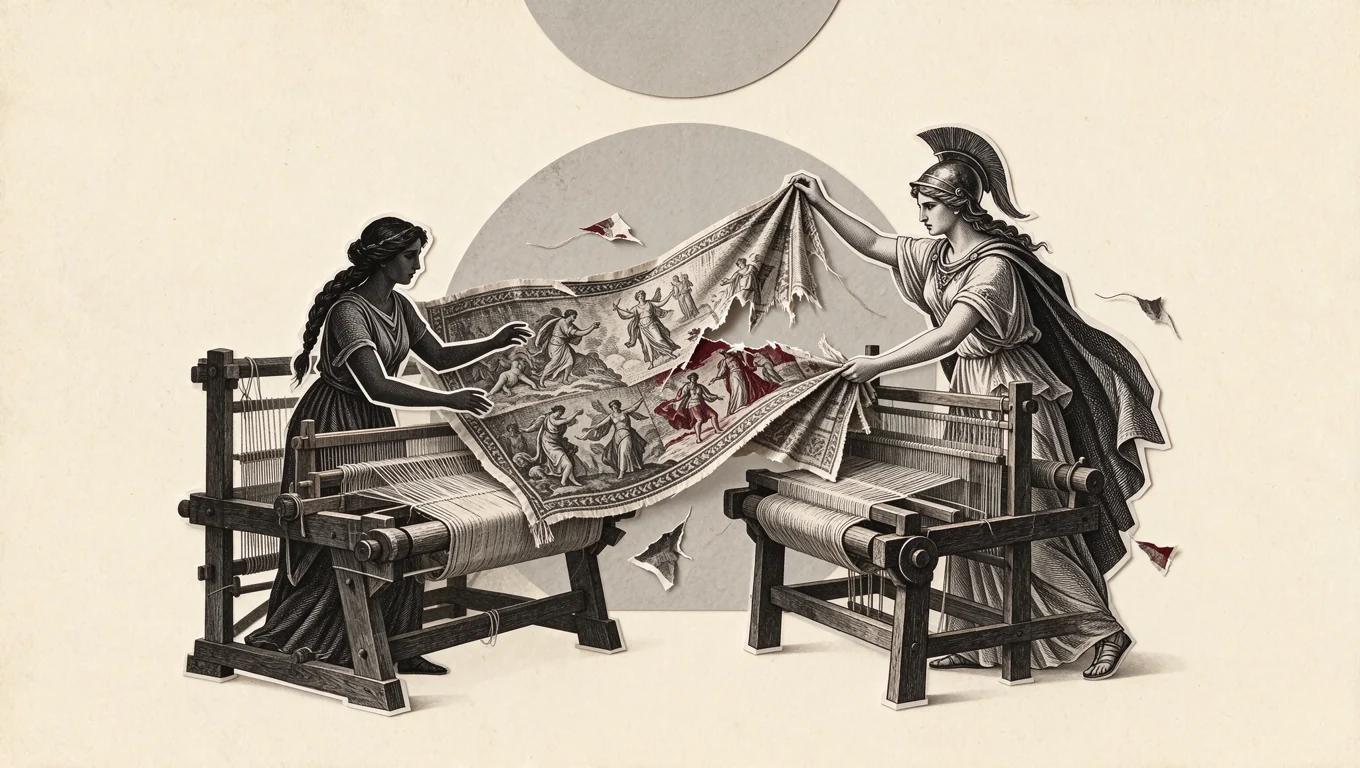
Ovid does not solve the contest by revealing a clumsy mistake in Arachne’s weaving. The poem says that even the goddess and Envy could find no fault with the work. Minerva’s anger falls instead upon its subject and its challenge. She tears the cloth and strikes Arachne. At this point the source becomes deeply distressing, including a desperate act of self-harm. We shorten that violence here without turning it into a fair judging of an inferior tapestry. The confrontation has moved beyond criticism of a work into the power to injure its maker.
Minerva prevents Arachne’s death, but the rescue carries a sentence. Arachne becomes a spider, her body altered and her thread now spun from herself. Her descendants will continue that hanging, weaving life. The ending gives the familiar web an unsettling story behind it. Something of the artist’s making survives, yet the conditions of her life have been imposed by the authority she challenged. Look again at the thin thread crossing an open space: it can suggest skill and persistence, but the poem has also made it a reminder of punishment, anger and unequal power.
Ovid’s Metamorphoses 6 is the principal surviving version used here. Its violent and distressing episode is softened in this family retelling, not erased from the source.
A Roman poem, not a universal fable
Metamorphoses 6.1–145 is the principal source for this account. Ovid uses Minerva and Jupiter, the Roman names, while later retellings often substitute Athena and Zeus. This adaptation retains the Roman setting of the literary telling and identifies those equivalents. It does not claim to recover a single story told unchanged throughout Greece and Rome.
Calling Arachne merely proud leaves out the poem’s attention to her real accomplishment. Calling Minerva merely a patient teacher leaves out her destruction of the work. A reader can examine the competing pictures, the right to represent harm and the difference between artistic judgement and coercion. These are interpretive questions raised by the narrative; they do not turn Arachne into a documented historical artist. The source’s assault and self-harm are acknowledged here in restrained terms.
A gifted mortal weaver whose reputation rests on her work.
Minerva
The Roman goddess of weaving and wisdom; Athena is her Greek counterpart.
Idmon
Arachne’s father, a dyer in Ovid’s account.
Reading beside this telling
Related reading for this story and its named tradition. Modern retellings and other translations are distinguished from the exact sources used above.
Metamorphoses — Ovid, translated by Mary M. Innes
For this story’s Ovid reference: read Book 6 in Mary M. Innes’s prose translation of Metamorphoses. The open source linked above uses its own translation; compare named passages, not identical wording.
Optional purchases. Use what you already have. As an Amazon Associate I earn from qualifying purchases. Check the exact edition or model before buying.