Scroll through the scenes or use the chapter links. The sources and version notes follow the story.
When the story or a chapter is focused, use arrow keys to change scenes, Home for the beginning, and End for the ending.
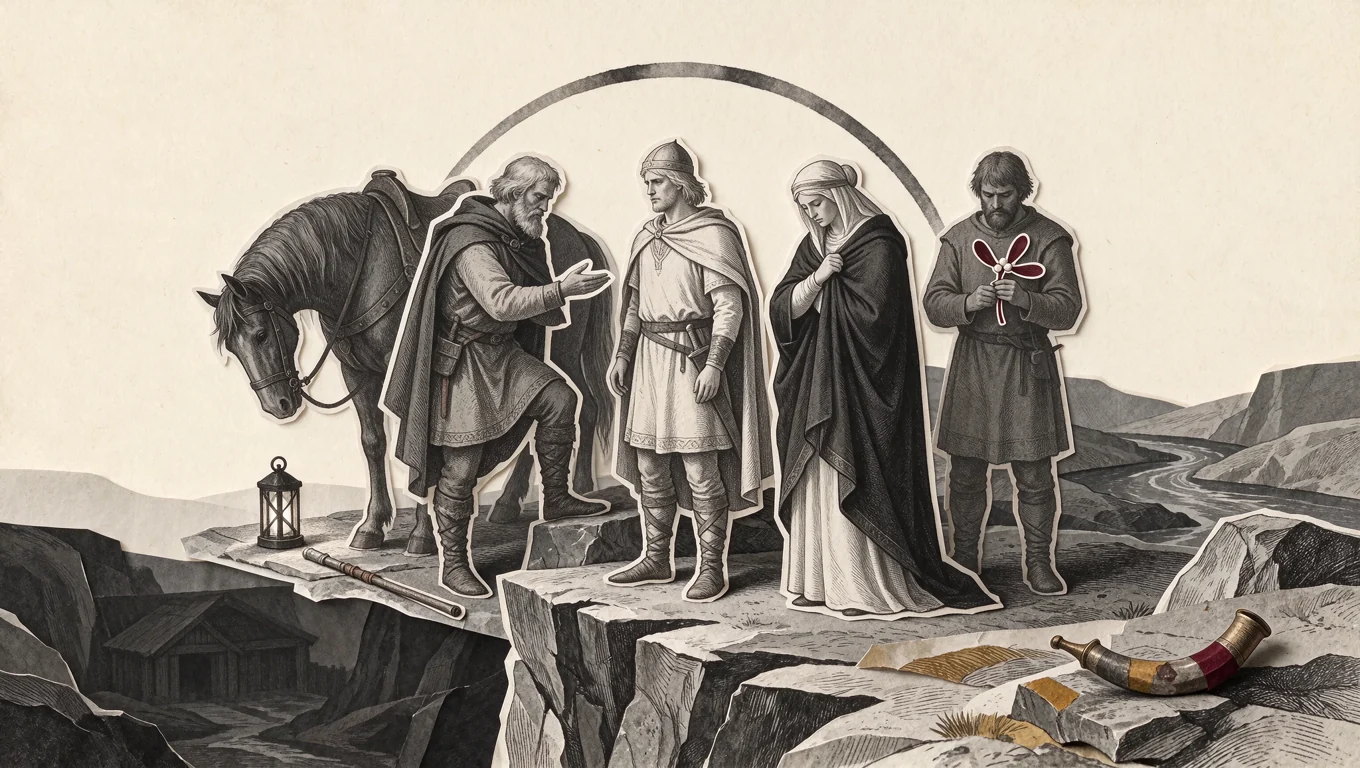
Reused interpretive art from our Baldr telling evokes the messenger’s departure and the grieving company; its grouped figures are not a literal diagram of the journey.
01
An embassy, not a conquest
Baldr has died, and Frigg asks who will travel to Hel to seek his return. Hermóðr accepts. He is not sent to storm a fortress or win a prize by strength. He is to find the dead god and ask whether a way home can be arranged. That distinction gives the journey its tension. A swift horse and a willing rider can cross great distances, but they cannot decide the terms waiting at the far end. Around the embassy lies the grief of the divine company. Hermóðr carries a request made by those who remain alive, and the hope that someone beyond their reach may answer it.
Sleipnir is led out for the journey. The horse belongs to Odin; Hermóðr mounts and rides away. Naming the horse makes the departure more than a change of scenery. The messenger has been given extraordinary means, but he still needs direction, permission and an answer. The horse can carry him where an ordinary journey would fail; it cannot promise that the one he seeks will be allowed to follow him home. Speed and strength belong to the means of the embassy, not to its answer. Beyond the departure, the prose opens into a long darkness.
Hermóðr rides for nine nights through valleys so deep and dark that he sees nothing ahead. The duration is allowed to matter. There is no sequence of illustrated monsters to distract from the uncertainty, and no claim that each night corresponds to one securely mapped world. Distance is being measured through endurance. The rider continues without knowing what his next sight will be. For the living who sent him, the same interval is a wait with no report. The prose holds the two conditions apart: motion on the road and stillness at home. Neither knows yet whether the embassy can succeed.
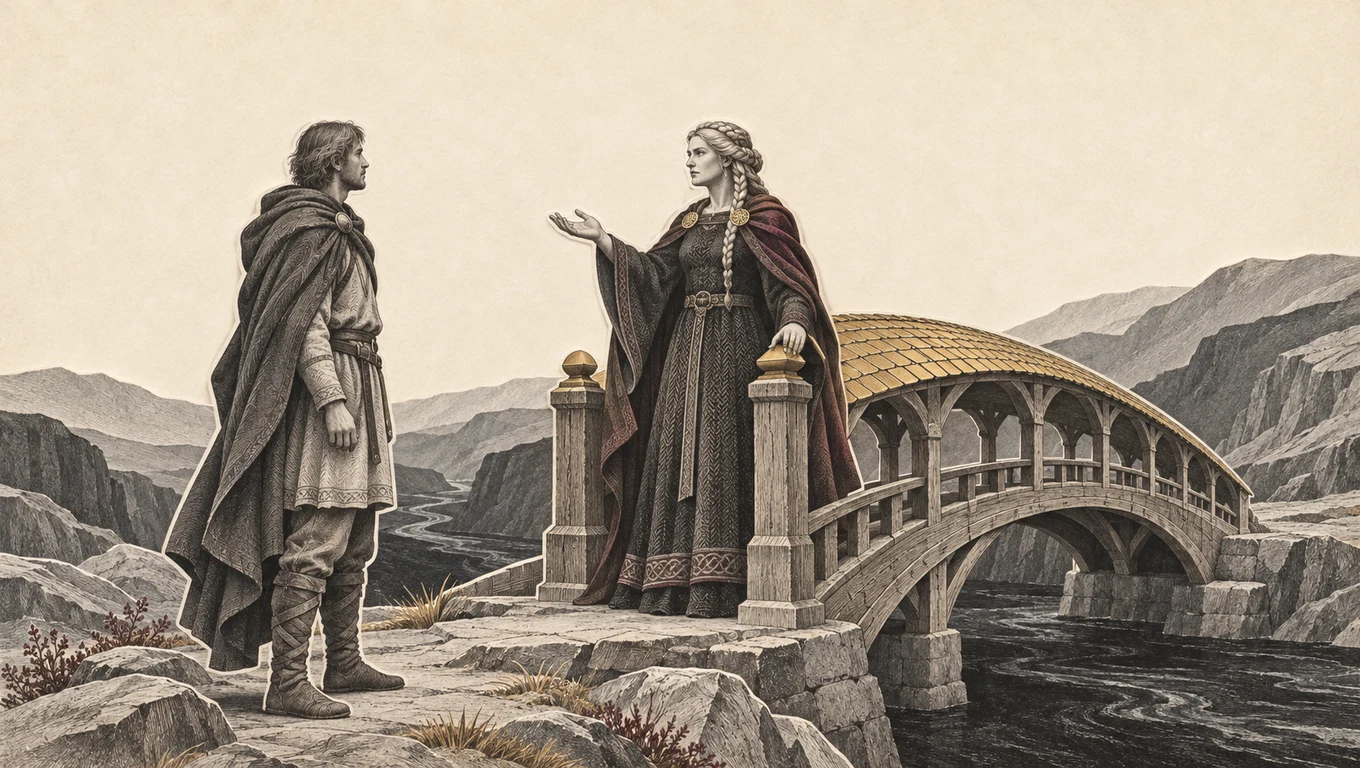
The exchange at Gjöll is interpreted as a meeting at the bridge. Hermóðr’s horse is outside the frame; the picture does not supply a literal map.
04
A bridge that answers the hoofbeats
At last Hermóðr reaches the river Gjöll and a bridge covered in shining gold. Móðguðr guards the crossing. She has seen companies of the dead pass over it, yet this one rider makes it thunder beneath him. He also lacks the appearance of the dead. Her questions interrupt his progress in a useful way: before he can find Baldr, he must say who he is and why he has come. The difference between a living visitor and the dead who belong on this road is recognised by sound and sight. The bridge is a threshold with a witness, not simply an obstacle to leap.
Móðguðr distinguishes Hermóðr from the dead through his appearance and the noise of his crossing. The episode does not make every traveller on this road the same kind of being. Her questions establish the visitor’s status before offering directions.
Hermóðr explains that he is seeking Baldr. Móðguðr has seen him pass and tells the rider where the road continues. The guidance is brief, but it changes the journey. The embassy is no longer searching without a trace. Someone has recognised the person he seeks. Hermóðr goes onward toward Hel’s gate, dismounts, tightens the horse’s girths and mounts again. The small preparation comes before the extraordinary leap. Sleipnir clears the gate. Even here the scene does not end with a defeated guardian or a captured kingdom. The rider has gained entry, and the real work of asking is still before him.
Inside, Hermóðr finds Baldr seated in honour. The dead brother is not merely an empty space that must be filled at home; he is present in another company. Hermóðr stays the night. The narrative pauses with them rather than rushing straight to a bargain. The next morning he speaks to Hel of the grief among the gods and asks that Baldr ride back with him. What he offers is the force of a shared loss. It is a powerful appeal, but not a command. Hel’s response will test the claim about how widely that love extends.
Hel sets a condition: everything, living and lifeless, must weep for Baldr if he is to return. A refusal from even one thing will prevent it. The scale of the task changes abruptly. One rider could make the outward journey; no single rider can supply the response of the whole world. Hermóðr has gone as far as courage and movement can take him. Now he must return with a message that others must carry onward. The condition offers a possibility while making its completion dependent on countless beings and things beyond the messenger’s control.
Baldr sends the ring Draupnir back to Odin. Nanna sends gifts as well. Hermóðr leaves with signs of a meeting, but without the person he was asked to bring home. Those objects matter because they prevent the return from being simply an empty-handed defeat. There has been contact across the division. There are things to deliver and words to repeat. The route back is not described at the same length as the route out. The narrative’s attention has shifted from the courage of reaching the hall to the responsibility of reporting what was actually said there.
Draupnir goes back to Odin, and Nanna sends gifts too. Hermóðr returns without Baldr, but not without a message or an exchange. Notice how the story distinguishes an unsuccessful request from a journey in which nothing happened.
Messengers ask the world to weep. People, creatures and even materials respond. The prose compares the tears of lifeless things with moisture that appears when cold objects meet warmth. Then Þökk, a giantess in a cave, refuses. The condition fails. Snorri reports the belief that she was Loki in disguise; this telling keeps that reported status visible. Baldr does not come home with Hermóðr. Yet the messenger has travelled, listened and returned truthfully. The ending leaves grief unresolved without pretending that the journey meant nothing. A road can bring knowledge and a last exchange even when it cannot bring back the person for whom it was taken.
An original adaptation focused on Hermóðr’s embassy in Gylfaginning, chapter 49, using the named Brodeur translation and Cambridge’s Old Norse and English extract. This is a closer view of an episode also present in our Baldr telling, not a newly recovered independent myth. Other sources and later retellings differ. A dedicated bridge illustration joins reused Baldr-cycle art. These are interpretations, not a literal map or a complete anatomical rendering of Sleipnir.
A medieval telling with a frame
Gylfaginning is a medieval literary work with its own speaking characters and purposes. Cambridge presents the ride as an extract from that work, with Old Norse beside an English translation. Neither the extract nor the full chapter gives access to a single unchanging belief held by every Norse community.
Hermóðr succeeds in reaching the dead and learning the condition of return. The larger plan nevertheless fails. That difference makes room for a reading of courage that does not depend on obtaining the wished-for result. It is an interpretation of the story’s shape, not a claim that the medieval text states a modern lesson about grief.
The messenger who undertakes the journey on Odin’s horse.
Baldr
The dead brother whom Hermóðr seeks to bring home.
Móðguðr
The guardian who questions the living rider at the bridge.
Hel
The ruler who sets a condition for Baldr’s release.
Frigg
Baldr’s mother, who asks for someone to undertake the embassy.
Reading beside this telling
Related reading for this story and its named tradition. Modern retellings and other translations are distinguished from the exact sources used above.
The Norse Myths — Kevin Crossley-Holland
For the Norse tradition: Kevin Crossley-Holland’s modern retellings. Follow this page’s Edda links for the named source; this collection is not an edition of those same translations.
Optional purchases. Use what you already have. As an Amazon Associate I earn from qualifying purchases. Check the exact edition or model before buying.