Scroll through the scenes or use the chapter links. The sources and version notes follow the story.
When the story or a chapter is focused, use arrow keys to change scenes, Home for the beginning, and End for the ending.
01
An island without a way out
Crete lay around Daedalus like an unfinished problem. He could design astonishing things, but he could not simply choose a ship and sail away with his son. Minos held power over their departure. In the Library’s account, the king had confined father and son in the labyrinth after Theseus escaped. The maker of winding passages had become a prisoner of the world he helped construct. Daedalus began to consider a direction that no guarded harbour could close: the open air above the island.
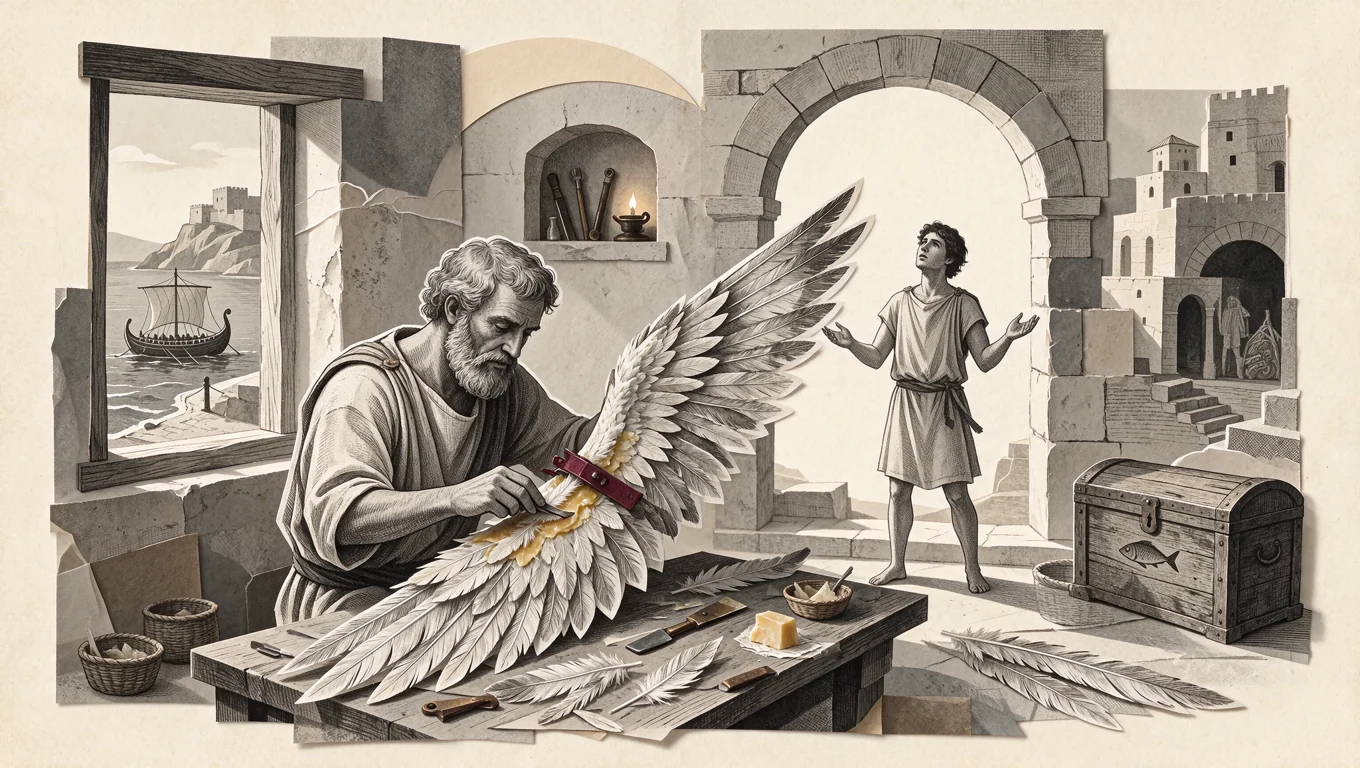
A bird’s wing was no single piece. Its feathers overlapped, small beside large, each contributing to a surface that could carry a body. Daedalus arranged his materials with the patience of a craftsman. Ovid describes feathers ordered by length, bound with thread and fixed with wax, then curved toward the shape of living wings. The escape would depend on the joins holding together. The same hands that had made a maze were now attempting something stranger: a path without walls, laid through a substance no foot could stand upon.
Icarus was close enough to watch the invention take shape. In Ovid’s telling he played with feathers stirred by the air and pressed the soft wax, unaware of the danger hidden in these attractive materials. His father saw a route out of captivity; the child could still find a game in the pieces. Their different understanding matters. The wings were a marvel to look at, but they were also a fragile machine. Admiring them and knowing how to use them were not quite the same thing.
The warning is not simply “do not fly high.” Both the sea below and the heat above threaten the wings. Notice how that double danger changes the familiar ambition-only reading: Daedalus is asking for a course that can actually carry them home.
When the wings were ready, Daedalus tested his own pair. What had existed as a pattern on the workbench had to bear his weight. Ovid imagines him balancing in the moving air before turning to equip his son. The first success did not remove his anxiety. It made the next task more urgent: Icarus had to understand the conditions under which the device would work. Father and son were about to leave the security of solid ground with nothing but their skill, the air and the bindings between the feathers.
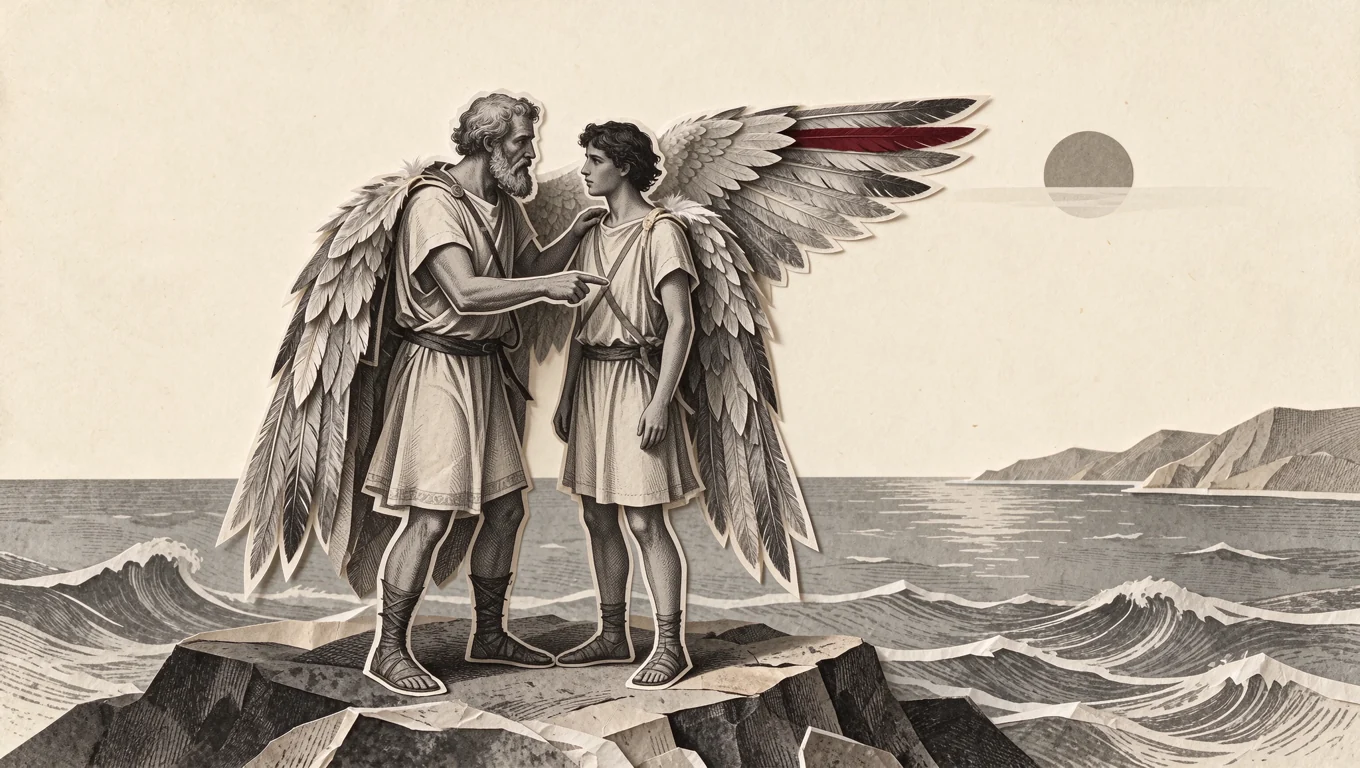
Daedalus gave two warnings, not one. If Icarus flew too close to the sea, dampness could weigh upon or loosen the feathers; if he climbed too high, the sun could soften their binding. The safe route lay between those dangers. He was to follow his father rather than choose his height by excitement alone. In Ovid, Daedalus fits the wings with trembling hands and gives his son a last kiss before leading the way. The instruction is practical, but the poem lets a reader feel the fear beneath it.
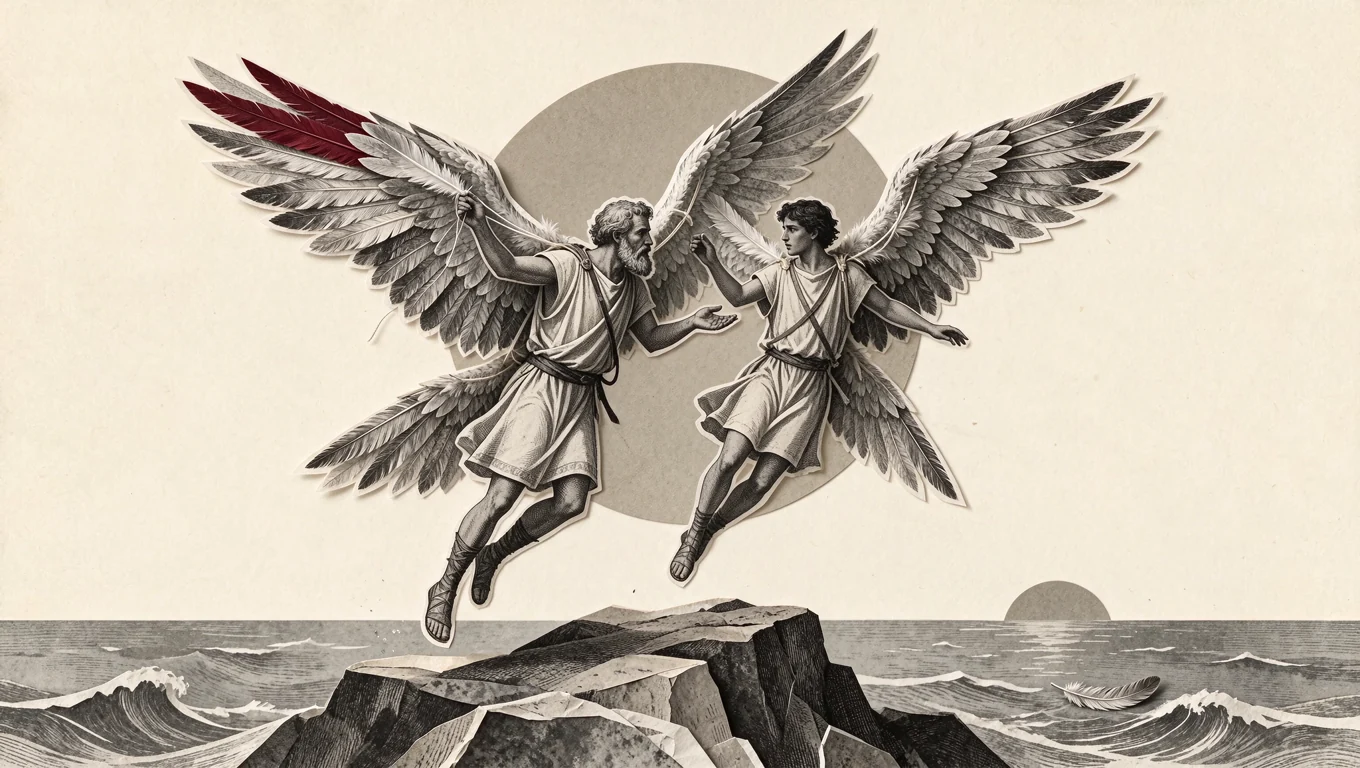
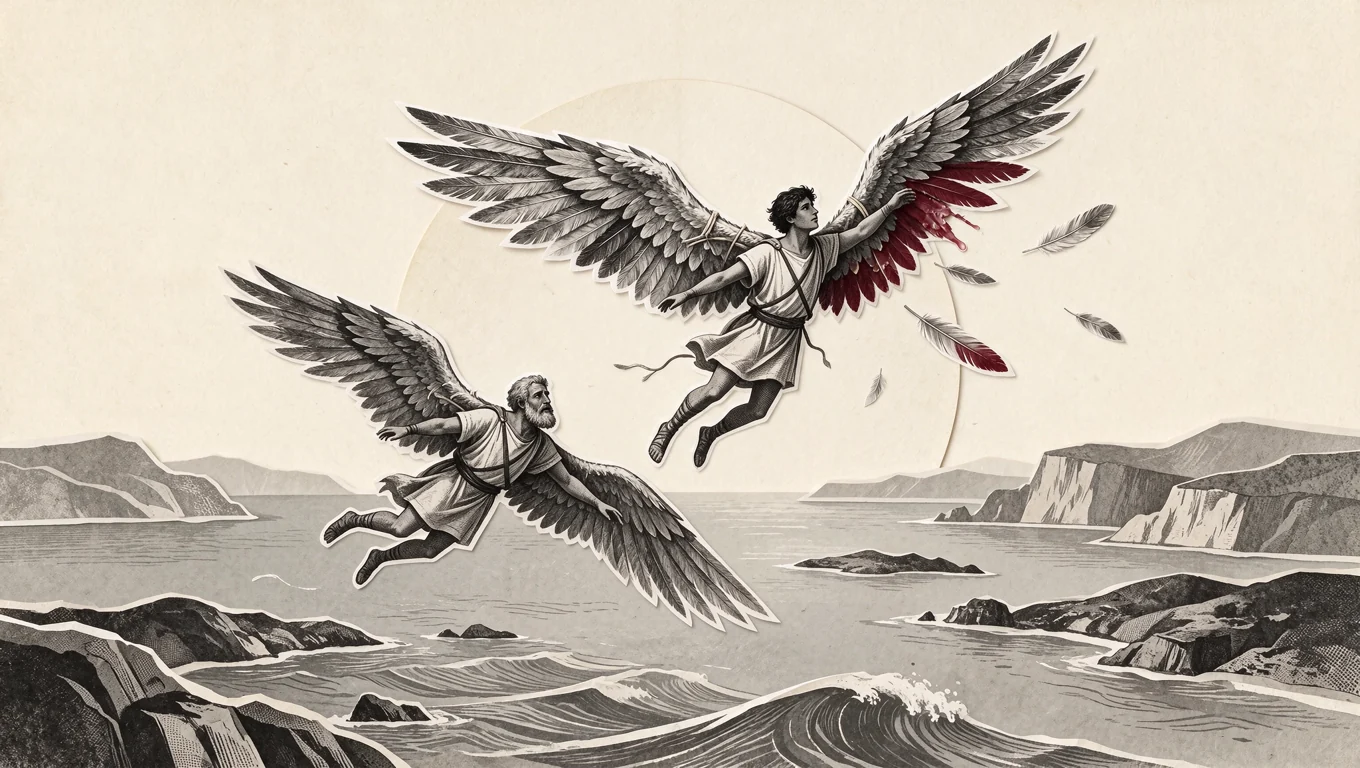
They lifted from Crete together. Daedalus went first, looking back as he guided Icarus into the unfamiliar work of flight. Below them, ordinary life continued: in Ovid’s poem, people fishing, tending animals and working the land look up at the extraordinary travellers. From the ground, the pair might seem divine. From within the flight, they were still a parent and a child managing a risky invention. The sea that had blocked their departure was now beneath them, crossed by a route no ship had taken.
For a while, the plan succeeded. Water and islands passed below; the wings carried them away from the place where Minos had held them. Nothing in that early movement told Icarus that failure was inevitable. The danger was more difficult than an enemy waiting visibly ahead: it lived in the limits of the very thing that was keeping him aloft. Ovid names islands along the journey, making this impossible passage feel briefly like a voyage with recognisable shores. Escape had become real enough for caution to begin slipping from attention.
Icarus climbed. The delight of moving through the sky drew him away from the course his father had set. The wings still answered for a little while, and then the warmth reached the wax. What had held separate feathers together began to fail. This is the terrible reversal at the centre of the story: the invention does not stop being beautiful when it becomes unsafe. The scattered pieces are still feathers, but they no longer form a wing. Icarus’s arms cannot do the work the whole construction had been doing.
In the marginTwo writers, different room to breathe+
The Library gives a compact account; Ovid spends longer with the workshop, instruction and grief. Compare how much time each writer grants the father before deciding that every detail belongs to one fixed ancient version.
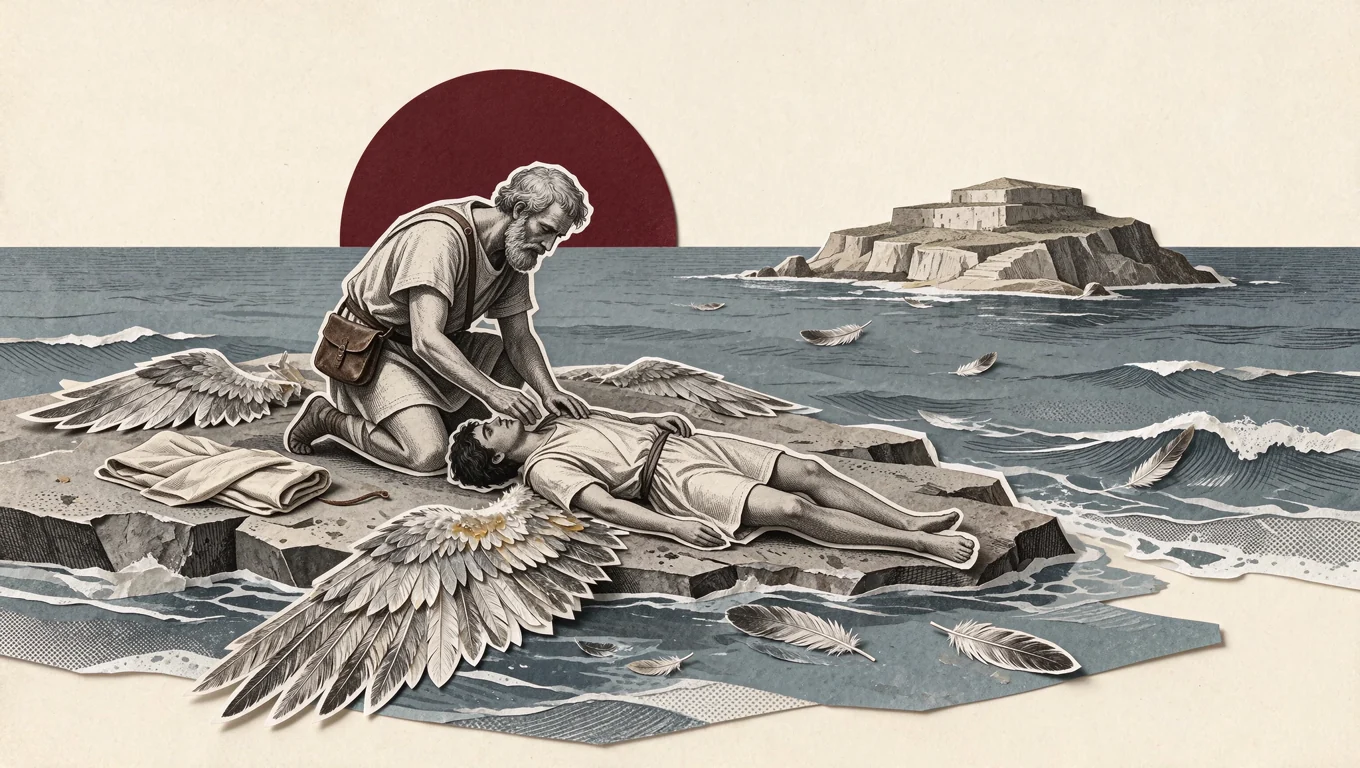
He fell into the sea and died. His father could not close the distance in time. Ovid gives the moment an unbearable change in scale: a figure who had seemed a wonder in the sky becomes someone a parent must search for on the water. Daedalus calls for Icarus and sees the signs of the broken wings. His ability has brought them out of Crete, but it cannot now undo what has happened. The account leaves room for grief rather than turning the fall into a triumphant demonstration of a rule.
Daedalus found his son and buried him. Ovid associates the island and the surrounding sea with Icarus’s name; the Library gives a shorter account of the fall and continues Daedalus’s journey toward Sicily. Here we remain for a moment at the shore. The father has escaped, yet the freedom he sought is inseparable from the person he has lost. The wings have shown both human ingenuity and its limits. Long after the flight ends, the story keeps asking us to look at the maker, the child and the space between them.
This telling uses Apollodorus, Library, Epitome 1.12–13, alongside the more expansive flight episode in Ovid, Metamorphoses 8.183–235. The workshop, last kiss and burial follow Ovid. The two-sided warning appears in both accounts.
Two ancient tellings
The Library, Epitome 1.12–13, supplies a compact account of confinement, wings, warnings and loss. Ovid’s Metamorphoses 8.183–235 gives the workshop, the anxious instruction and the grief on the shore more room. This retelling identifies those added details rather than treating two literary accounts as one eyewitness report. Neither is evidence that a historical flight took place.
It is tempting to reduce Icarus to a warning against ambition. The presence of the lower danger complicates that reading: Daedalus asks for a viable course, not for the refusal of flight. His invention really does carry them away. A reader can attend to exhilaration, responsibility and parental fear at once. That is an interpretation offered here, not an ancient explanation attached to every version.
Inventor, father and guide; his skill creates the escape.
Icarus
His son, learning to fly while discovering the freedom of the air.
Minos
The Cretan king whose control makes escape necessary.
Reading beside this telling
Related reading for this story and its named tradition. Modern retellings and other translations are distinguished from the exact sources used above.
Metamorphoses — Ovid, translated by Mary M. Innes
For this story’s Ovid reference: read Book 8 in Mary M. Innes’s prose translation of Metamorphoses. The open source linked above uses its own translation; compare named passages, not identical wording.
Optional purchases. Use what you already have. As an Amazon Associate I earn from qualifying purchases. Check the exact edition or model before buying.