Scroll through the scenes or use the chapter links. The sources and version notes follow the story.
When the story or a chapter is focused, use arrow keys to change scenes, Home for the beginning, and End for the ending.
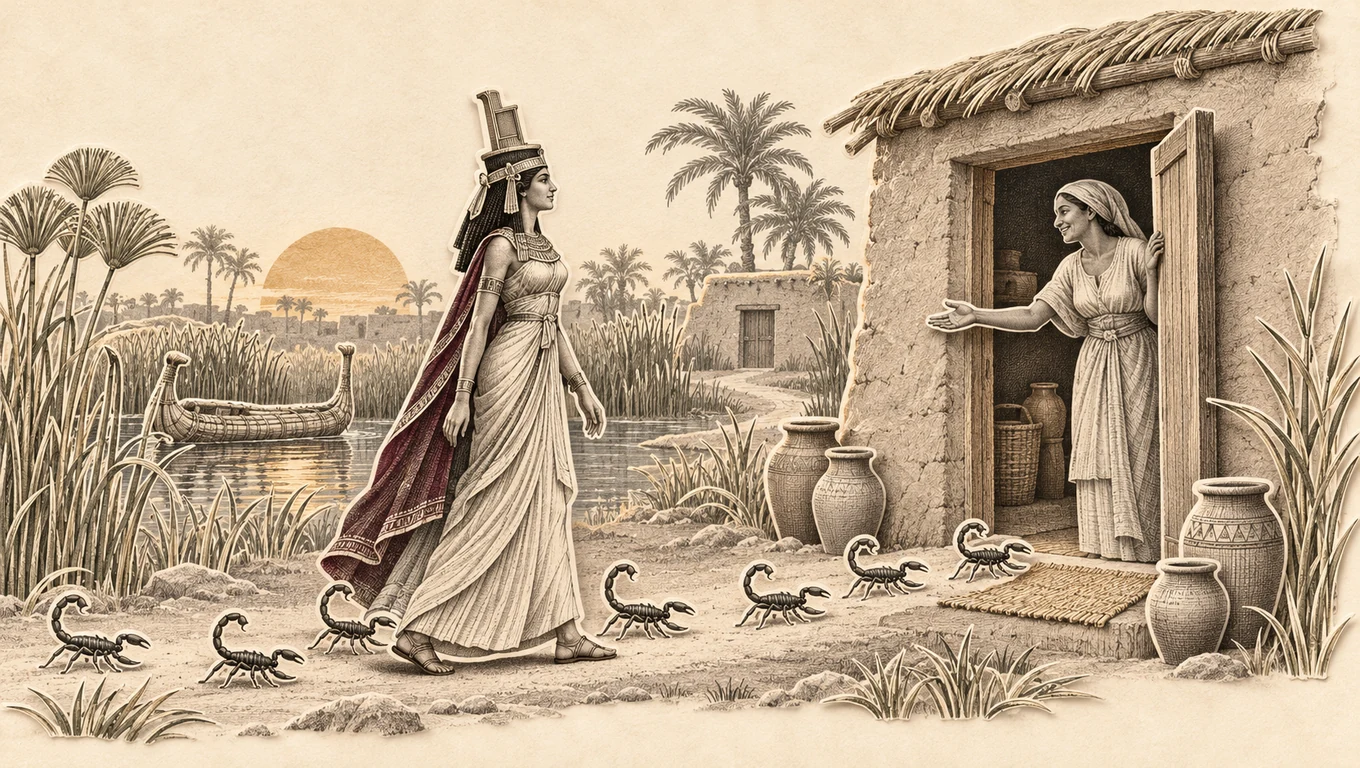
The illustration brings the journey and the later welcome into one tableau; the following chapters keep their sequence visible.
01
Leaving at evening
Isis comes out from confinement after the death of Osiris. Thoth has urged her to protect the child whose future is still ahead of him. The journey begins with the need for concealment, not with a procession of triumph. Seven scorpions accompany the goddess. They are dangerous guardians around someone who is herself vulnerable. Their presence makes the coming encounter uncertain: a stranger seeking help can also seem frightening to the person at the door. The tale lets those two facts exist together. Isis needs somewhere to rest, but the company travelling with her is not easy to welcome.
The translation names the scorpions and places them around Isis: some behind, some beside her, others ahead preparing the way. They form an escort rather than an anonymous swarm. The goddess charges them to be restrained as they travel. This detail matters when their behaviour changes. Protection is not the same thing as permission to attack anyone who causes offence. The road brings the group toward inhabited ground at the edge of the marshes. Somewhere among the houses there must be a place where a fugitive can stay, if someone is prepared to open a door.
A woman sees the escort and refuses entry. A poorer woman, named Taha in Budge’s translation, opens her home instead. The movement between the two doorways gives the story a simple shape: need is met in the house that has less to give. It is tempting to stop there and turn the scene into a tidy contrast between wealth and kindness. The narrative does not stop. Those who have been refused carry their anger away from the threshold. The shelter already found by Isis is not enough to satisfy them. A slight to their company becomes the excuse for something much worse.
The injured child in this household belongs to the woman who refused shelter. Horus is endangered elsewhere in the larger collection. Merging the children would turn a rescue beyond Isis’s family into a different story.
The scorpions combine their venom in Tefen’s sting. Tefen enters beneath the closed door and stings the woman’s son. The person suffering the retaliation is a child, not the person who refused hospitality. That separation is the story’s turning point. A punishment presented as repayment for an insult has reached someone who did not make the choice. The householder calls out for help, and her distress crosses the boundary she had tried to keep firm. The account describes a child near death; this adaptation leaves the suffering unpictured and keeps attention on what the goddess does when she hears the cry.
Isis does not accept the injury as a satisfactory defence of her honour. She hears the mother and goes to the child. Her own experience of loss and the child’s innocence meet in the decision to intervene. She speaks against the gathered poisons, naming the scorpions whose force has been combined. Speech separates and drives out what revenge brought together. In the world of the text, the child is restored. The scene does not ask the reader to repeat an ancient treatment. It shows what a healing narrative can do with a conflict: it can interrupt the demand that pain must be answered with more pain.
The Metternich Stela carries protective texts and images, while smaller Horus stelae could be portable. Those surviving objects help explain a setting for healing stories. They do not establish that recitation neutralises venom.
The child lives. The householder’s response is not another refusal. She brings possessions from her home, and the poor woman’s house receives the gifts. The ending remembers both kinds of help: the goddess who removes the danger and the host who gave shelter before there was any reward to expect. It also remembers the difference between loyalty and cruelty. The scorpions could guard Isis on the road, but their anger was not a sound measure of justice. A door has opened between the households. The story closes with restored life and changed obligations, leaving the reader to consider how much wider protection can become when it is no longer confined to one’s own companions.
An original adaptation of the Narrative of Isis on the Metternich Stela, using Budge’s named 1912 translation alongside museum and university context. The episode of the householder’s child is kept distinct from the later poisoning of Horus. Ancient healing beliefs are described as beliefs. A new illustration interprets the seven companions and the welcome at the doorway. The goddess cutout is reused from the wider Isis cycle. No image is presented as an ancient object.
Which child is in danger?
This episode concerns the son of the woman who refuses hospitality. The same larger textual collection also tells of Horus in danger, but those are not interchangeable children. Keeping the episodes distinct changes the ethical shape of the rescue: Isis helps someone outside her own family, despite the rejection that began the crisis.
The Met dates the stela to 360–343 BCE and describes its protective inscriptions. UCL also documents smaller portable Horus stelae. These objects help explain how divine stories entered attempts at healing. They are evidence for the making and use of such objects, not evidence that a goddess literally visited a particular house or that recited spells neutralise venom.
A fugitive goddess whose protection extends beyond her own household.
The seven scorpions
Companions whose response to rejection endangers a child.
Taha
The poorer woman who gives shelter in Budge’s translation.
The householder and her son
The woman who closes her door and the child who suffers retaliation.
Reading beside this telling
Related reading for this story and its named tradition. Modern retellings and other translations are distinguished from the exact sources used above.
Egyptian Myths — Jean Menzies
For the Egyptian tradition behind this story: a modern illustrated collection. Keep the museum evidence and this later retelling distinct; this is not an ancient primary source.
For another modern approach to retelling Egyptian stories. Compare version choices rather than assuming it reproduces the exact source used on this page.
Optional purchases. Use what you already have. As an Amazon Associate I earn from qualifying purchases. Check the exact edition or model before buying.