Scroll through the scenes or use the chapter links. The sources and version notes follow the story.
When the story or a chapter is focused, use arrow keys to change scenes, Home for the beginning, and End for the ending.
01
A family after sorrow
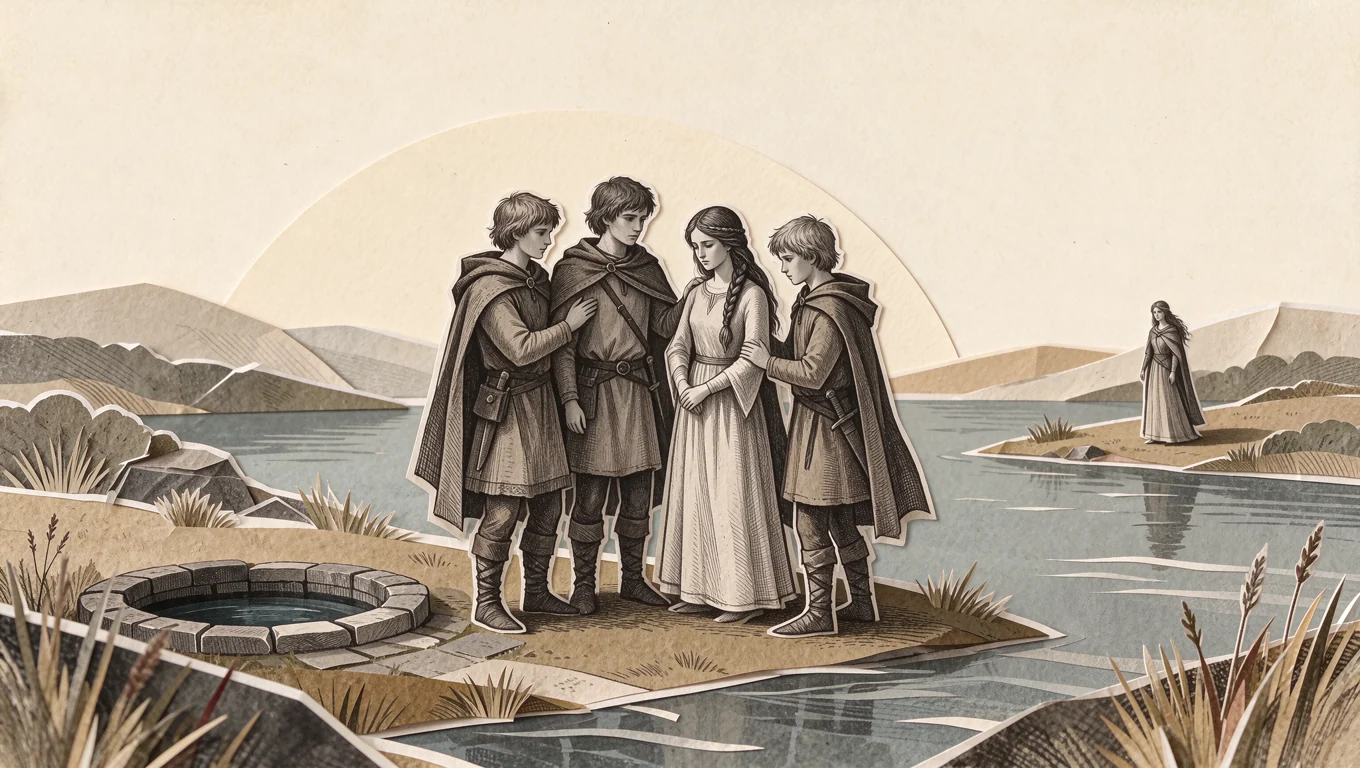
Lir had four children: Fionnghuala and Aodh, then the younger brothers Fiachra and Conn. Their mother died, and love for the children sustained their father through his grief. He later married her sister Aoife. In the CELT telling, Aoife at first felt affection for the children too. Its tragedy grows within a family, where care, attention and the wish to be loved become the ground on which jealousy takes hold.
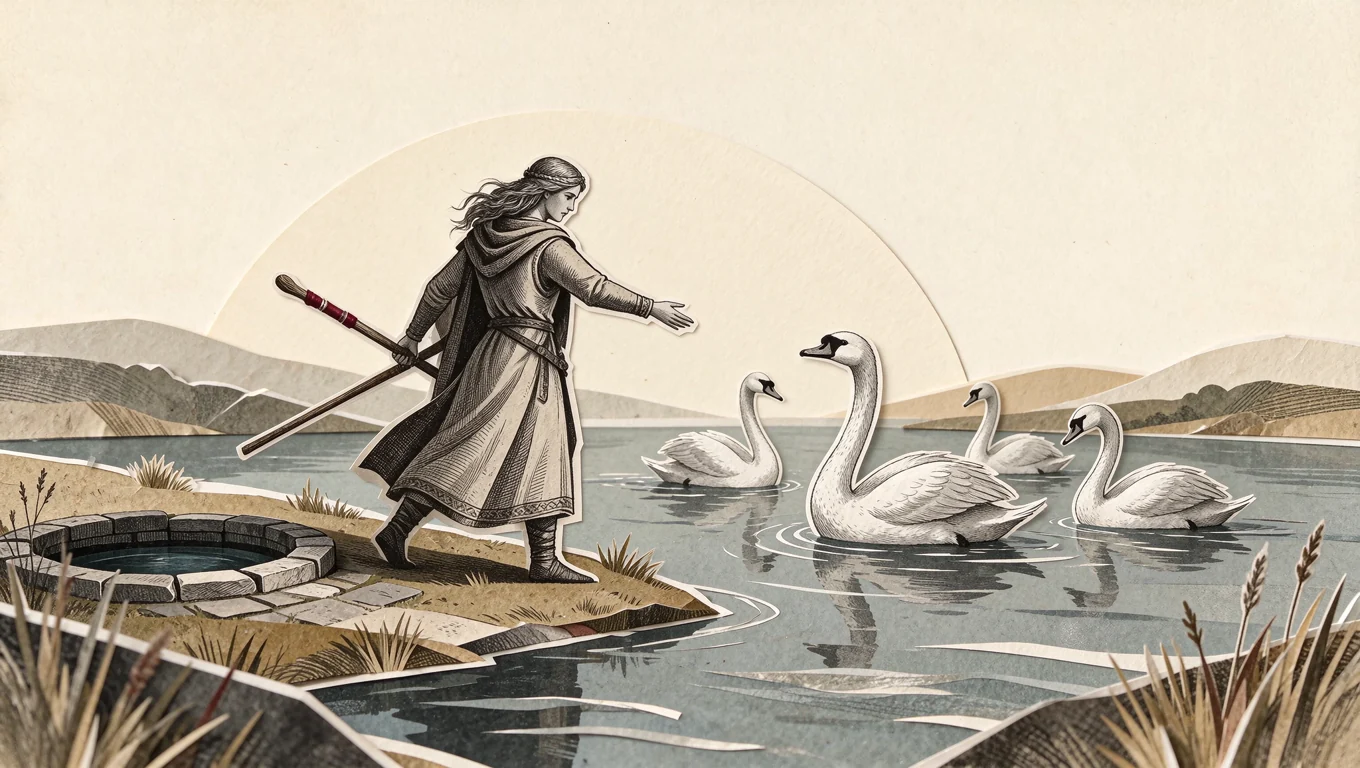
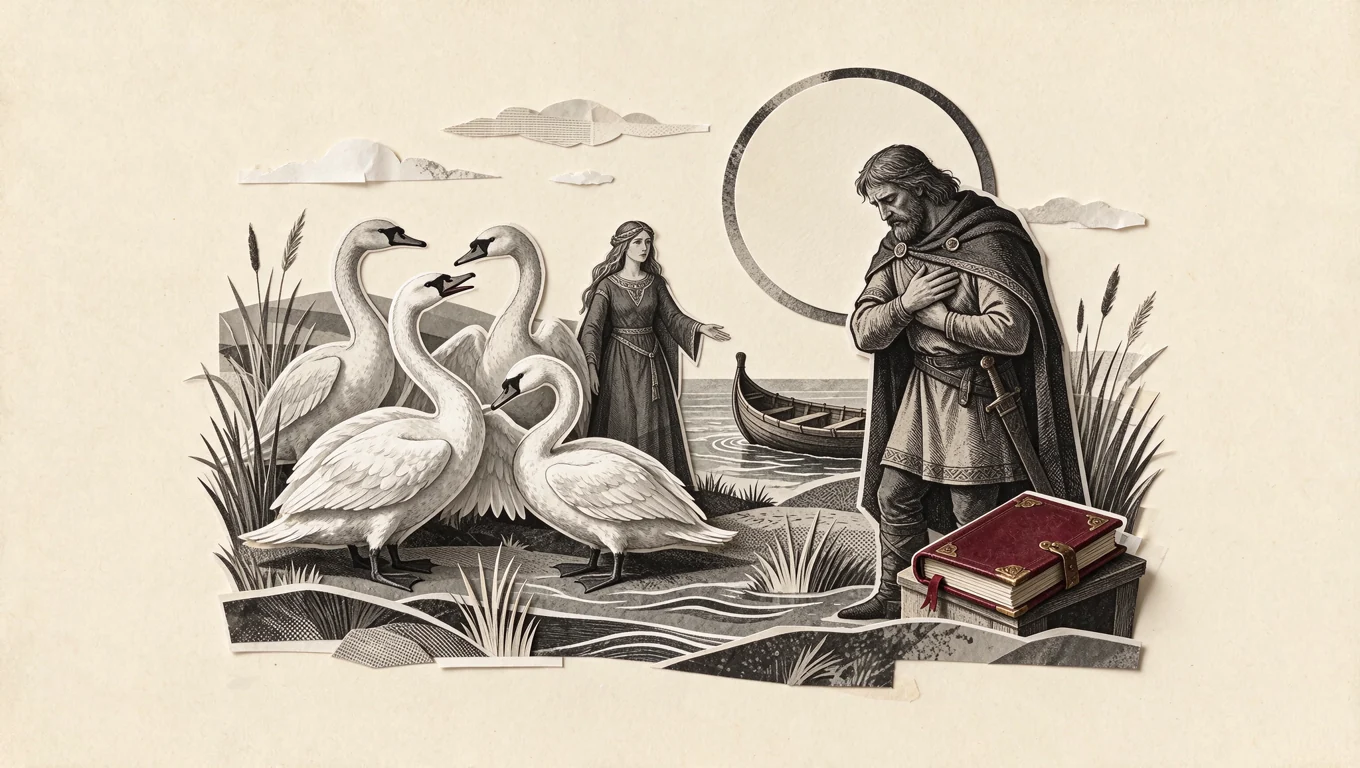
Aoife came to resent the affection the children received. She took them on a journey and sought to have them killed, but her companions would not carry out that harm. The source continues through a threatening confrontation; this retelling keeps it non-graphic. At the lakeside, Aoife used a transforming wand upon the children. Their human bodies were taken from them, and four white swans appeared upon the water. The change did not make the wrong less serious. It replaced an immediate danger with a life whose losses would unfold across a very long time.
The children turned toward one another in their new forms. Fionnghuala addressed Aoife and demanded to know the limit of what she had done. Aoife left them their reason, memory and human speech, together with music of extraordinary beauty. Those gifts would allow them to remain recognisable to one another and to tell others who they were. They would not restore the ordinary life of the household. The swans could still love, speak and remember; it was precisely that continuity which made them able to understand the scale of their separation.
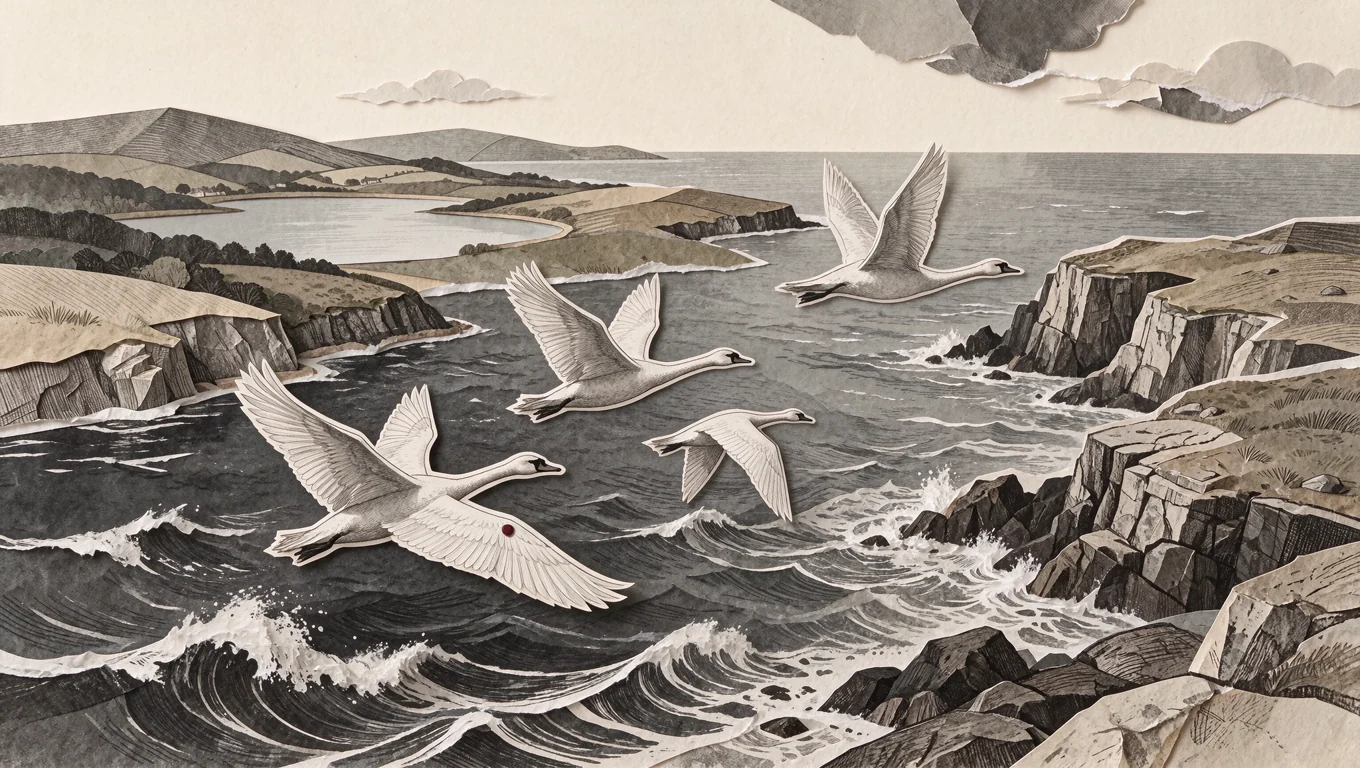
The term of the spell was immense. The siblings were to spend three hundred years on Loch Dairbhreach, three hundred on the narrow sea between Ireland and Scotland, and three hundred in the western waters around Iorrus Domhnann and Inis Gluaire. The account also ties their eventual release to a later union of named people from north and south. For the children, the conditions were a future too distant to picture. For the reader, the three waters give the long endurance a changing geography.
In the marginCount the waters, not just the years+
The exile unfolds in three long periods rather than one undifferentiated stay on a lake. The different waters give care, exposure and memory room to change. They are the narrative’s geography, not proof of an archaeological route.
Lir learned that the children had not reached the people they were meant to visit. He went looking for them and came to the lake, where he heard human voices from the swans. Fionnghuala told him who they were and what Aoife had done. Recognition brought both relief and grief: they were alive, but he could not take them home in their former shape. He and his company listened to their music beside the water. The father could still hear his children, yet the shore had become a boundary between the life he knew and the one they must endure.
During the first part of their sentence, people could come to listen. The beauty of the siblings’ singing gave them a way to remain connected with human company. It did not make the years ordinary or cancel the knowledge that the lake was only the first stage. The time appointed there eventually ended, and they had to leave for harsher waters. The story lets a period of relative companionship precede the cold of the narrow sea.
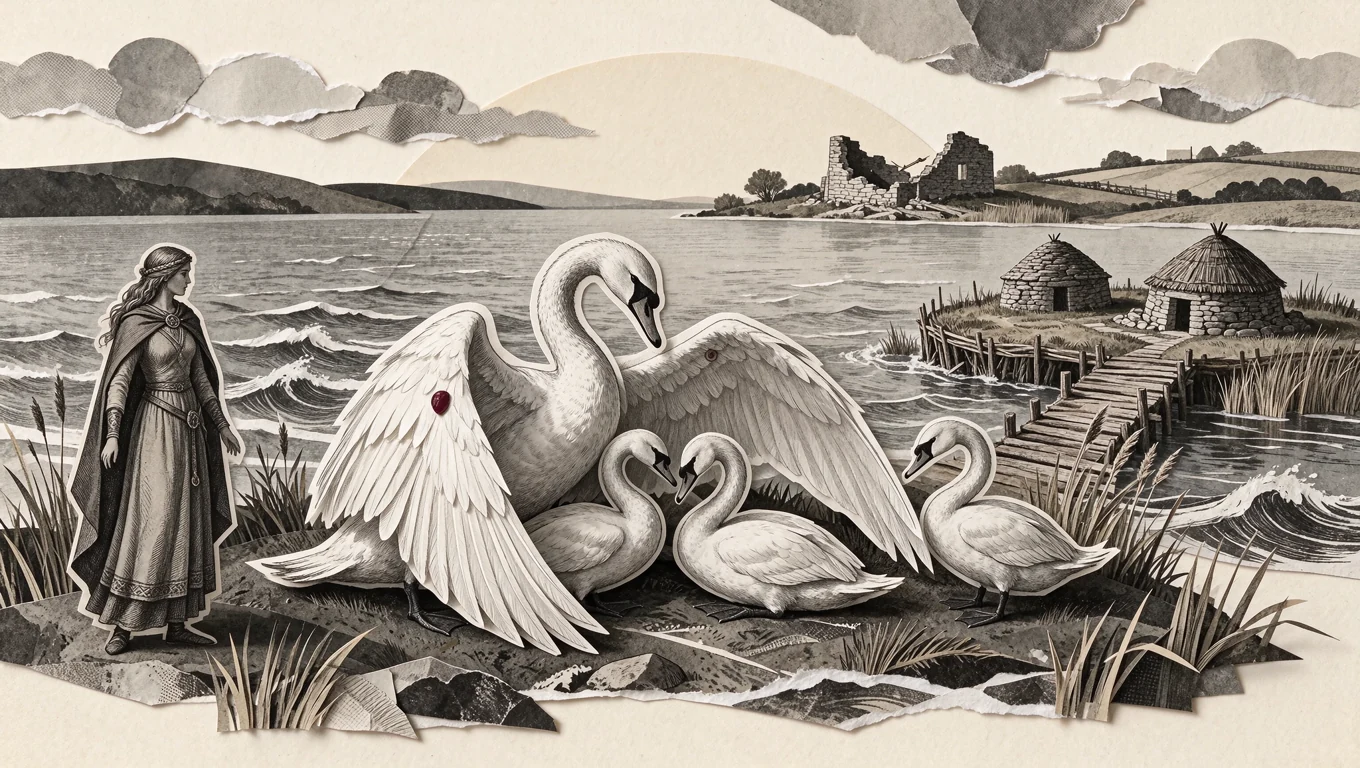
On the sea between Ireland and Scotland, the siblings endured cold, wind and separation. Fionnghuala gathered her brothers beneath her wings when she could, making shelter with the body the spell had given her. The swan’s form, imposed as a loss, became something through which she could care for them. Their survival depended on finding one another again and keeping company through the weather. This telling does not make suffering a price they deserved to pay. It follows the practical tenderness with which they answered a sentence none of them had chosen.
When the time on the narrow sea was completed, the four went west for the remaining portion of their sentence. The world continued changing around their repeated journeys. People who had known them could not live through the whole span beside them. Familiar places would no longer offer the same welcome simply because the birds remembered them. The length of the spell is therefore more than a large number. It separates the children from generations of human companionship, while leaving memory alive enough to notice what has vanished.
The tale brings the swans back toward places associated with their earlier life, only to find desolation where their remembered company had been. Home is no longer waiting unchanged at the end of the journey. That recognition gives the final movement its sorrow even before their bodies alter again. The siblings have remained a family through the centuries, but endurance cannot preserve everyone and everything around them. Their voices and their care for one another carry a past that the landscape can no longer entirely return. They must meet the world that exists now.
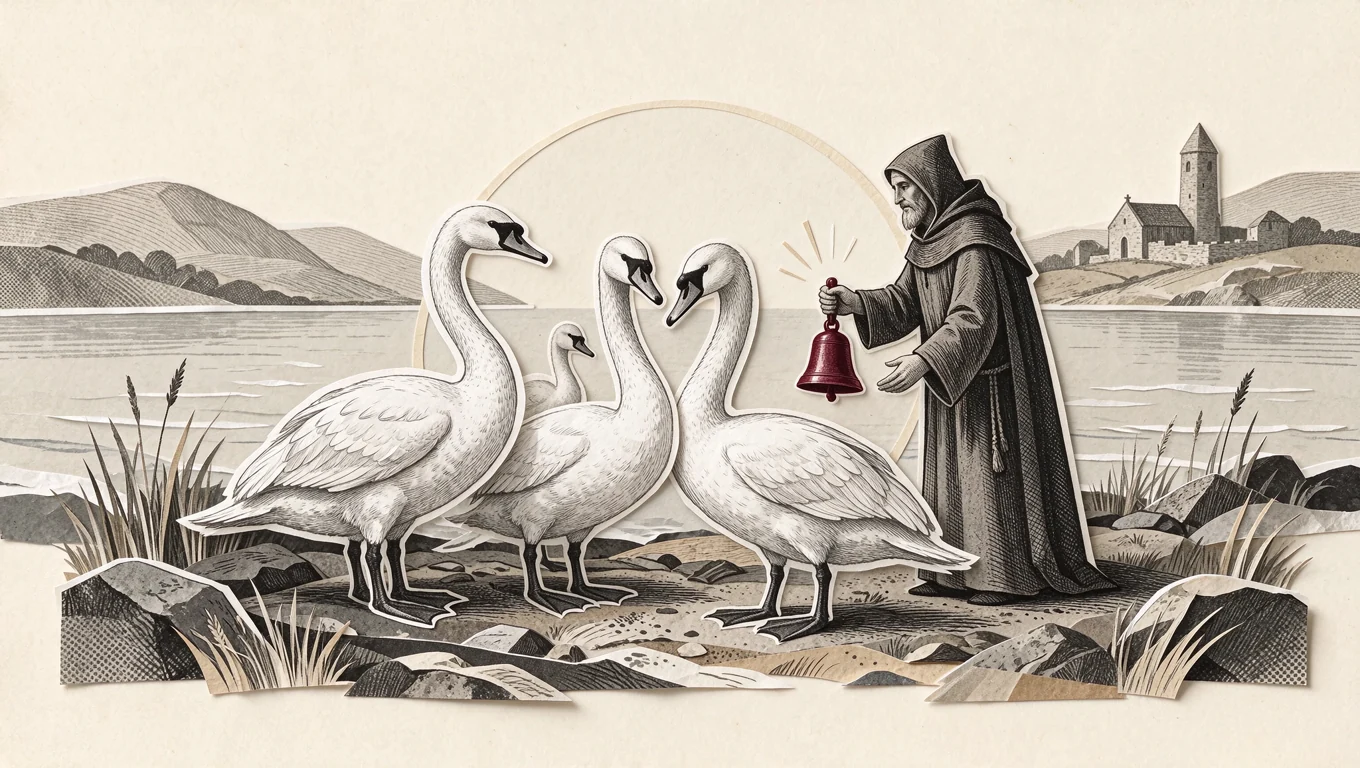
They heard a bell and came into the company of a cleric, Mochaomhóg. The CELT telling places this meeting within a Christian conclusion: the birds hear the offices and find a period of safety with him. The bell marks a changed religious world as well as a sound reaching across the water. It does not, by itself, complete every condition of the enchantment. Another human claim upon the birds is about to disturb their refuge.
In the CELT telling, hearing the bell does not by itself turn the swans back into children. The later attempt to seize them belongs to the sequence too, followed by their aged bodies and burial together. A shortened ending can quietly change what the long endurance means.
Deoch, wife of Lairgnen, wanted the remarkable birds for herself. When the cleric would not surrender them, Lairgnen came and seized them. As his hands closed upon the swans, their feathered forms fell away. The children stood as very old people, the long years suddenly visible in their bodies. Their human shape had returned, but not their childhood. Fionnghuala asked the cleric to baptise them because death was near. The ending brings release and loss together rather than granting nine hundred years back to be lived over again.
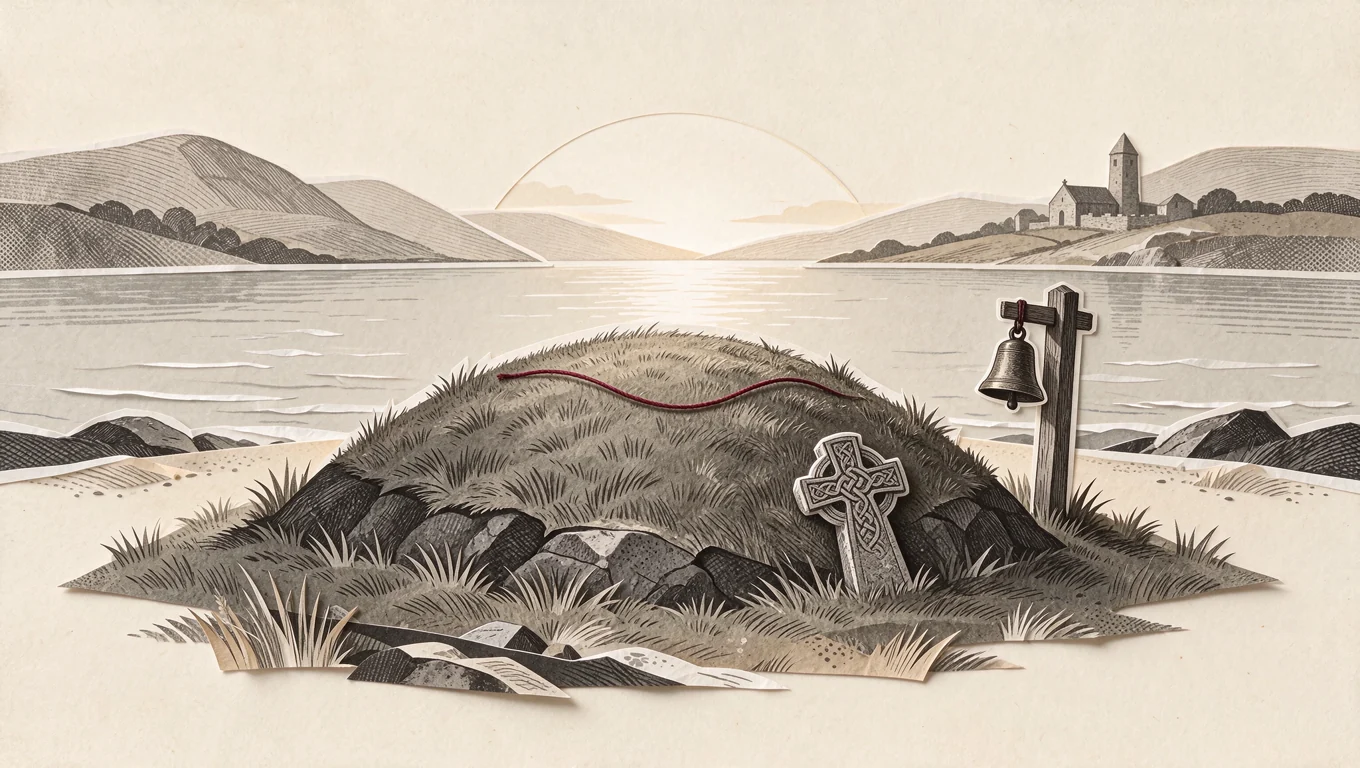
The siblings died and were buried together. Fionnghuala had asked that her brothers be placed close around her, carrying the pattern of her sheltering care into their final rest. The grave ends the travelling, but the telling preserves the family’s names and the long attention they gave one another. The spell could take away their forms and their home. It could not make their loyalty to one another disappear.
This retelling follows the UCC CELT translation of Oidheadh Chlainne Lir. It keeps the three periods of exile, the later seizure by Lairgnen, the briefly restored aged human forms, baptism and burial together. The manuscript and storytelling history includes variations; no single timeless Irish version is claimed.
The ending in this version
This adaptation follows the CELT translation of Oidheadh Chlainne Lir, based on the nineteenth-century O’Curry/O’Duffy edition. The cleric, baptism and the attempt to take the birds belong to that telling’s Christian conclusion. The spell does not end simply at the first bell. Some popular versions compress these events; this one keeps their order and the shared burial visible.
The names appear in several spellings across Irish texts and translations. This page uses Fionnghuala, Aodh, Fiachra and Conn consistently for the siblings. Its landscapes interpret the three stages of their exile rather than supplying an archaeological map. The story can be read through displacement, memory and protective care without claiming that these are the only meanings its long history permits.
The sister whose voice and sheltering care help hold the family together.
Aodh, Fiachra and Conn
Her three brothers, sharing the spell and the long journey.
Lir
Their grieving father.
Aoife
Their mother’s sister and Lir’s later wife, who transforms them.
Mochaomhóg
The cleric who gives them refuge near the end.
Reading beside this telling
Related reading for this story and its named tradition. Modern retellings and other translations are distinguished from the exact sources used above.
Early Irish Myths and Sagas — translated by Jeffrey Gantz
For context in early Irish literary traditions: Jeffrey Gantz’s named translations. This is related reading; it is not a claim that this particular tale occurs in the volume.
For broader context across Celtic traditions: a modern illustrated collection. Irish and Welsh traditions are distinct, and this book does not replace the linked CELT source.
Optional purchases. Use what you already have. As an Amazon Associate I earn from qualifying purchases. Check the exact edition or model before buying.