Scroll through the scenes or use the chapter links. The sources and version notes follow the story.
When the story or a chapter is focused, use arrow keys to change scenes, Home for the beginning, and End for the ending.
01
The earth opens
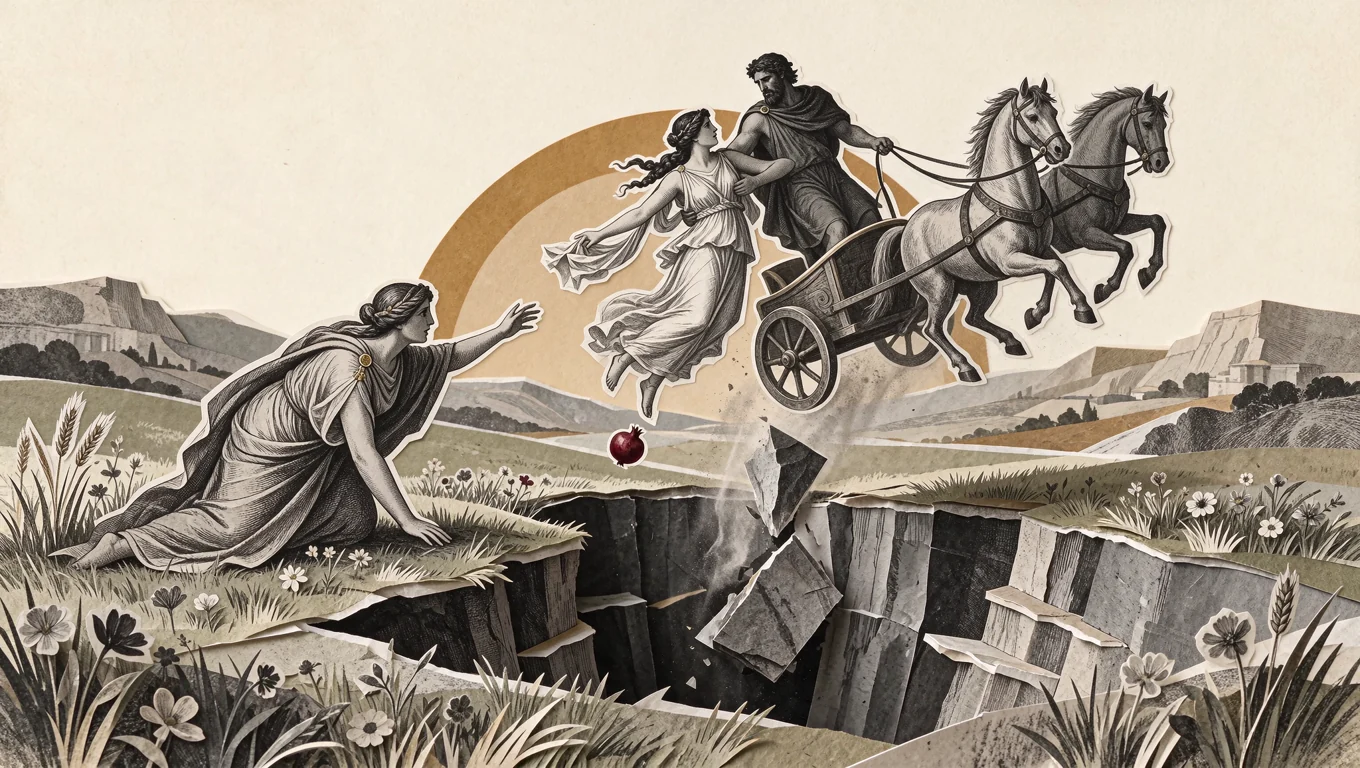
Persephone was among flowers when the ground opened. In the Homeric Hymn to Demeter, the beautiful narcissus draws her toward a trap, and Hades carries her away in his chariot. Zeus has permitted the taking; Persephone has not chosen it. Her cry reaches beyond the meadow to her mother. Demeter hears the voice, but hearing does not tell her where to go. The earth that bears the flowers has also hidden the passage by which her daughter disappears. A familiar world has become impossible to trust.
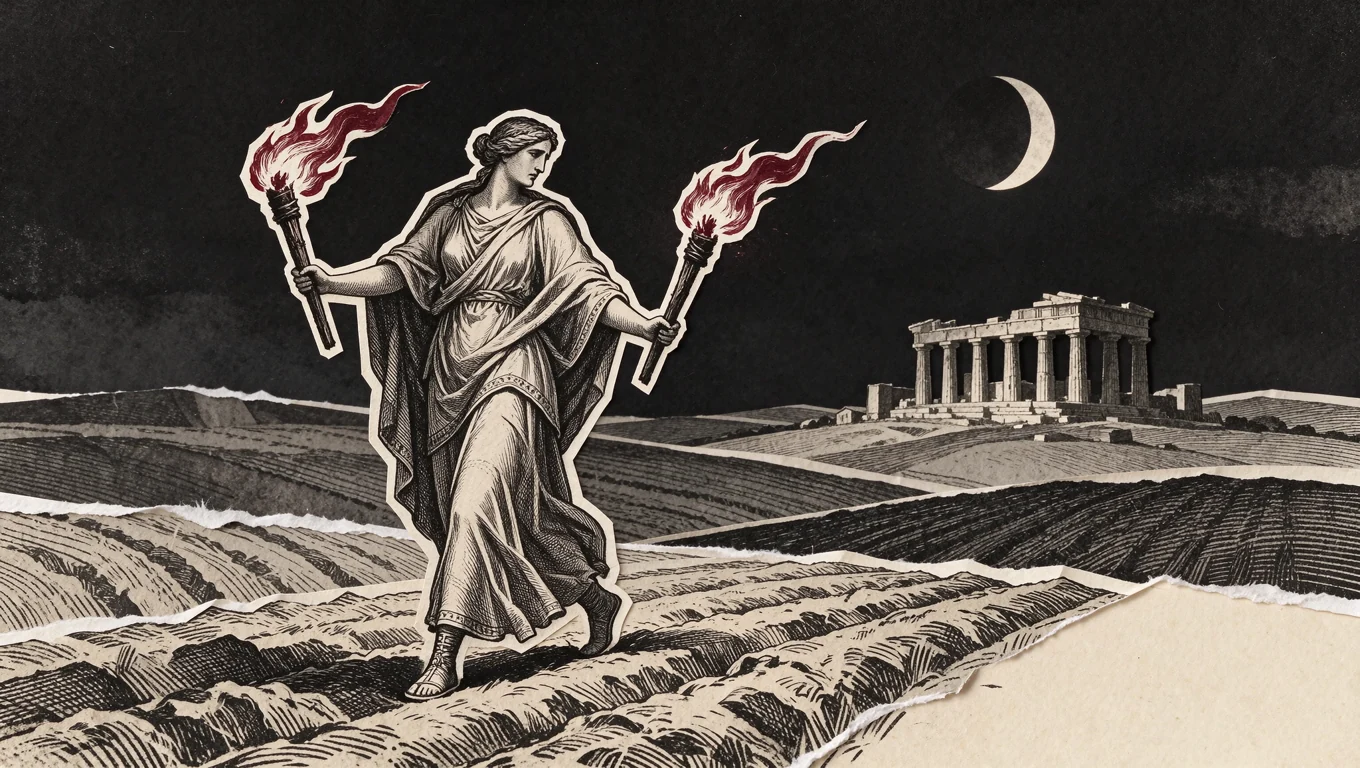
Demeter searched the earth with burning torches. For nine days she did not resume the ordinary life of the gods. Hecate had heard the cry but had not seen the abduction; the sun god Helios could tell her more. He revealed who had taken Persephone and the part Zeus had played. Knowledge did not settle Demeter’s grief. It gave her anger a direction. The loss belonged within the divine household itself, and returning obediently to that household would not bring her daughter back.
Leaving the gods, Demeter came among human beings in the appearance of an older woman. At Eleusis she was received into a household and cared for a child, Demophon. The hymn pauses here for a different kind of tending: the goddess who cannot reach her own daughter nourishes someone else’s son. Her divine identity remains hidden for a time. These passages give the story more than a journey between two worlds. They place grief inside the daily work of feeding, sheltering and looking after a child.
Demeter’s attempt to make Demophon immortal was interrupted when the child’s mother saw what she was doing and cried out. The goddess then revealed herself and required a temple at Eleusis. This shortened telling leaves the dangerous ritual undescribed, but the change is important: the visitor can no longer be treated as an ordinary nurse. Demeter withdrew into her temple. Her separation from the gods had become a separation with consequences for everyone who depended on the grain. The search for one daughter was entering the fields of the whole human world.
The hymn gives mortal hospitality a place in a divine dispute. Eleusis is part of the story’s geography and religious setting, not an interchangeable stop on a romantic journey. Demeter’s time among people makes the disappearance a story about relationships beyond the underworld.
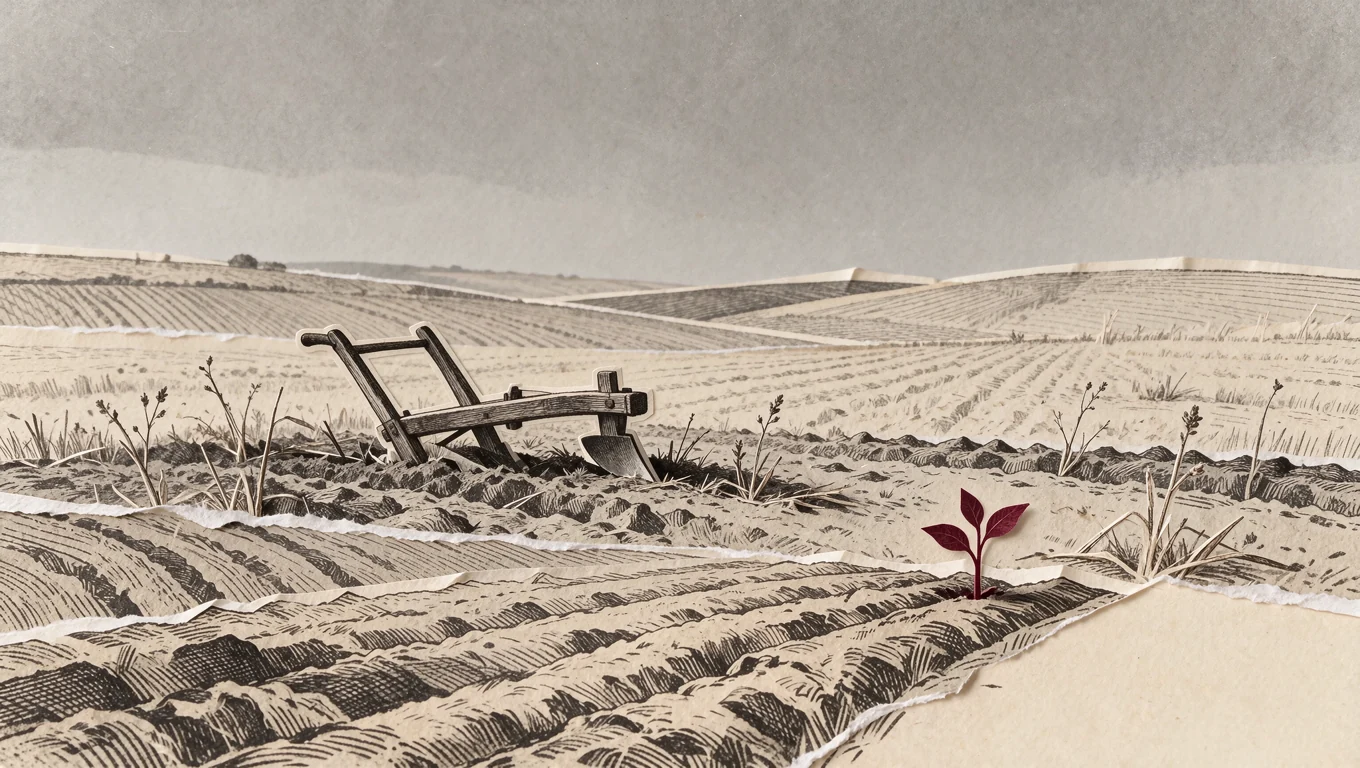
The earth would not yield its crop. People could plough and sow, but the seed remained without the growth that sustained their lives. The hymn presents this as Demeter’s action, not merely as bad weather accompanying her mood. Hunger threatens the human community, and the gods stand to lose the offerings that humans make. Demeter’s refusal therefore changes the balance of power. She cannot open the underworld by searching harder, but she can withhold something the order of the world needs. Zeus must respond to more than a mother’s private sorrow.
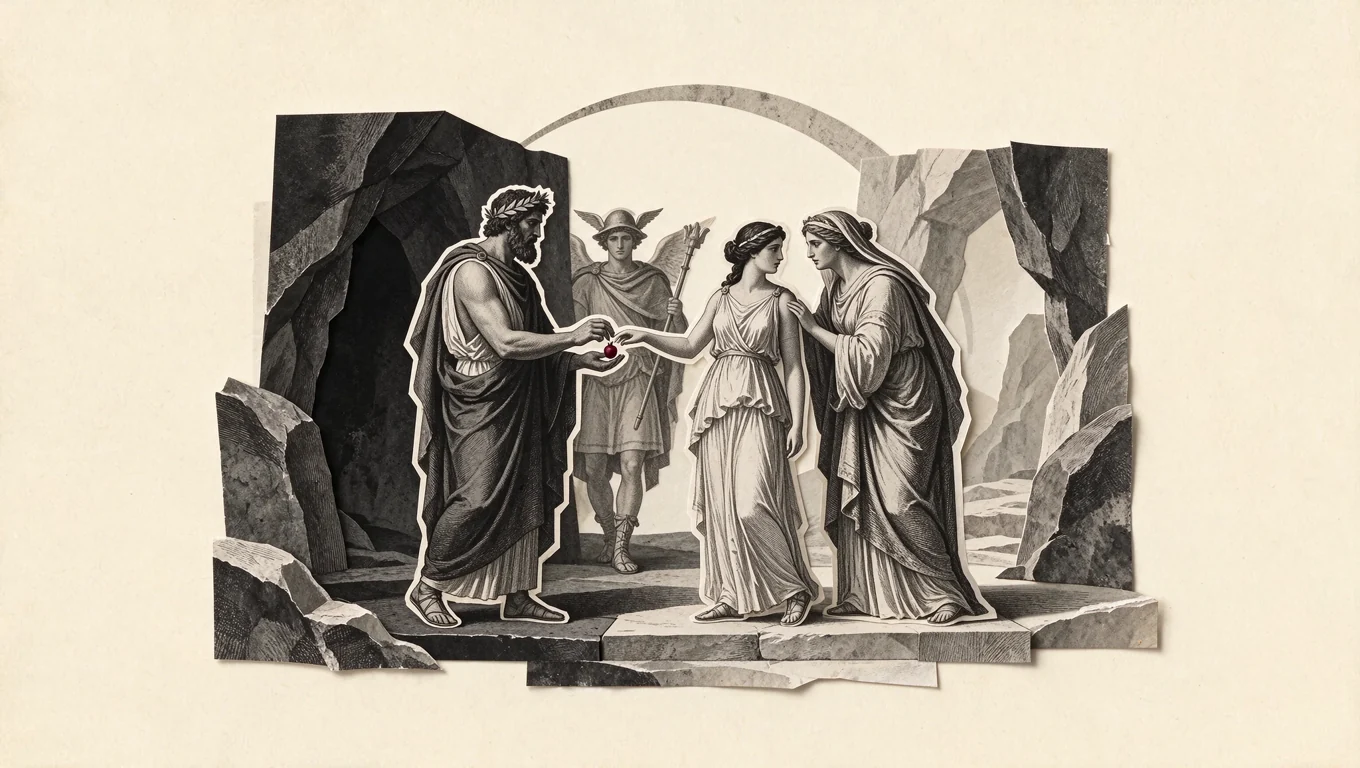
Messages and promises came to Demeter, but she would not restore the harvest without seeing Persephone. At last Zeus sent Hermes to Hades. The messenger’s task was to bring the daughter back so that her mother’s anger could end. Hades agreed to her departure. For Persephone, the possibility of return opened suddenly inside a place she had not freely entered. The hymn does not turn that promise into a simple resolution. Before the journey upward, a small piece of food changes the terms of what return can mean.
Hades gave Persephone a pomegranate seed. The hymn tells the incident twice in different voices: the narrator describes a concealed act, while Persephone later tells her mother that she was compelled to taste it against her will. That distinction matters. This is not a scene of a carefree girl forgetting a sensible warning. Food becomes a means of retaining a claim upon her. The seed is tiny beside the chariot and the powers arranging her life, yet it has consequences no strength of embrace will entirely remove.
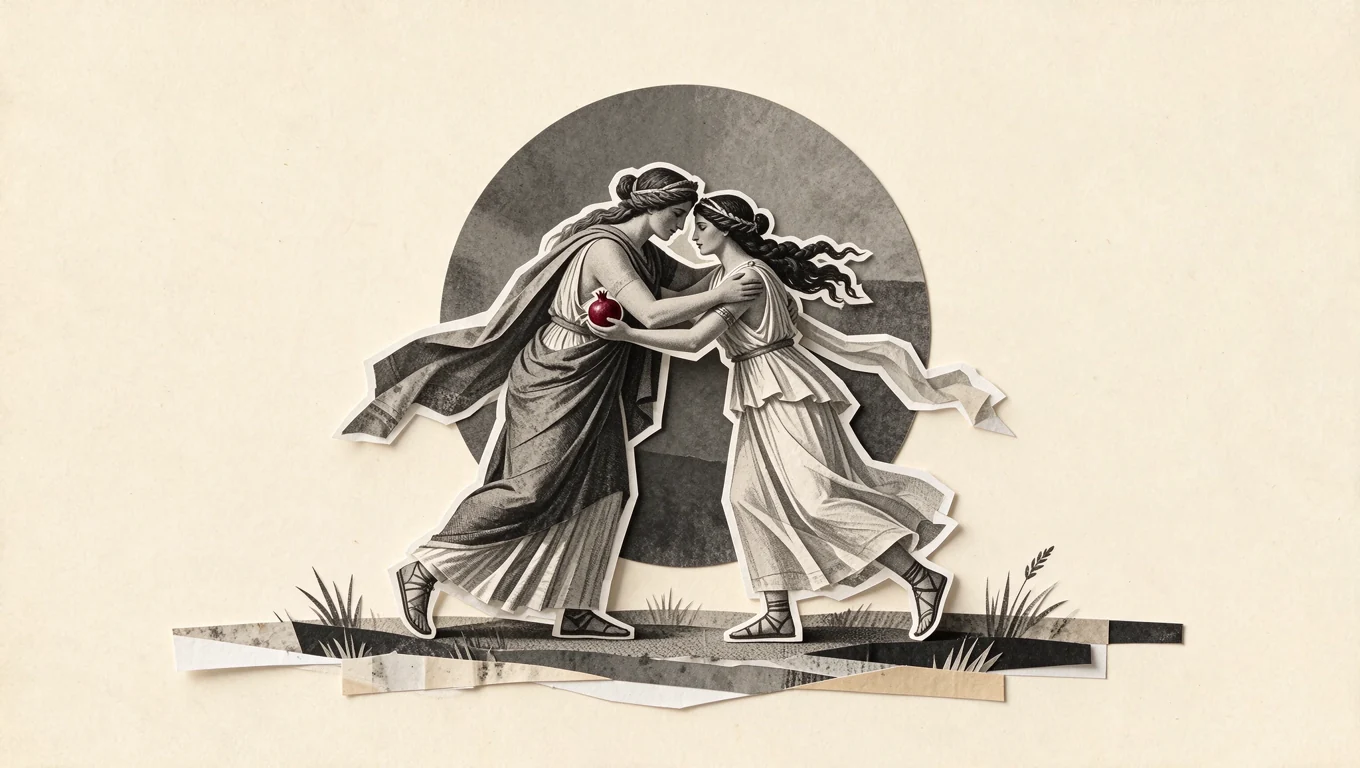
Hermes drove Persephone back, and mother and daughter rushed toward one another. The reunion is joyful, but Demeter needed to know whether her daughter had eaten below. Persephone told her what had happened. Their meeting contains both relief and the recognition that their lives cannot simply return to the day before the flowers. Hecate also joins the reunited pair and becomes Persephone’s attendant in the hymn. The daughter is again among those who love her, but the story must still find an arrangement between the worlds that have claimed her.
The settlement gives Persephone part of each year below and the rest with her mother and the other gods. In this hymn the division is one-third beneath the earth and two-thirds above, rather than a universal six-month rule. Rhea carries the agreement to Demeter. With her daughter restored to her for the greater portion of the year, Demeter lets the fields grow again. The return of grain ends the immediate threat of hunger. Reunion is real, but it is now a recurring passage rather than a permanent ending.
The hymn’s division is one third of the year below and two thirds with her mother. A six-month rule may belong to a familiar later retelling, but it should not quietly replace the proportion in the text being read here.
Demeter restored the earth’s abundance and showed sacred rites to the rulers at Eleusis. The hymn closes toward worship as well as agriculture: its concerns include the gods, the human community and what people hope for beyond death. This telling stops at the renewed fields without claiming to describe the secret rites. Flowers can return to the picture, yet the earlier violence is not undone. The rhythm of departure and reunion carries the story forward. Mother and daughter remain connected across a boundary neither of them has simply wished away.
This telling follows the Homeric Hymn to Demeter, including Eleusis, the seed given against Persephone’s will in her account, and the one-third/two-thirds division of the year. Dangerous rites are shortened without claiming that the source omits them. Other ancient versions differ.
Which seasons?
The hymn links Demeter’s withdrawal and return to the failure and renewal of grain. It does not give a modern meteorological diagram or establish that every Greek community explained every season in the same way. Its one-third/two-thirds division should not quietly become a six-seed, six-month rule borrowed from another retelling.
This version keeps the abduction and the coerced seed visible without graphic description. The hymn allows Persephone to report what happened to her; her own account should not be replaced by a cheerful romance. Readers can also notice Demeter’s dependence on mortal hospitality, her political leverage through grain and the significance of Eleusis. These threads belong together even when a short illustrated adaptation cannot follow every episode in full.
Optional purchases. Use what you already have. As an Amazon Associate I earn from qualifying purchases. Check the exact edition or model before buying.