Scroll through the scenes or use the chapter links. The sources and version notes follow the story.
When the story or a chapter is focused, use arrow keys to change scenes, Home for the beginning, and End for the ending.
01
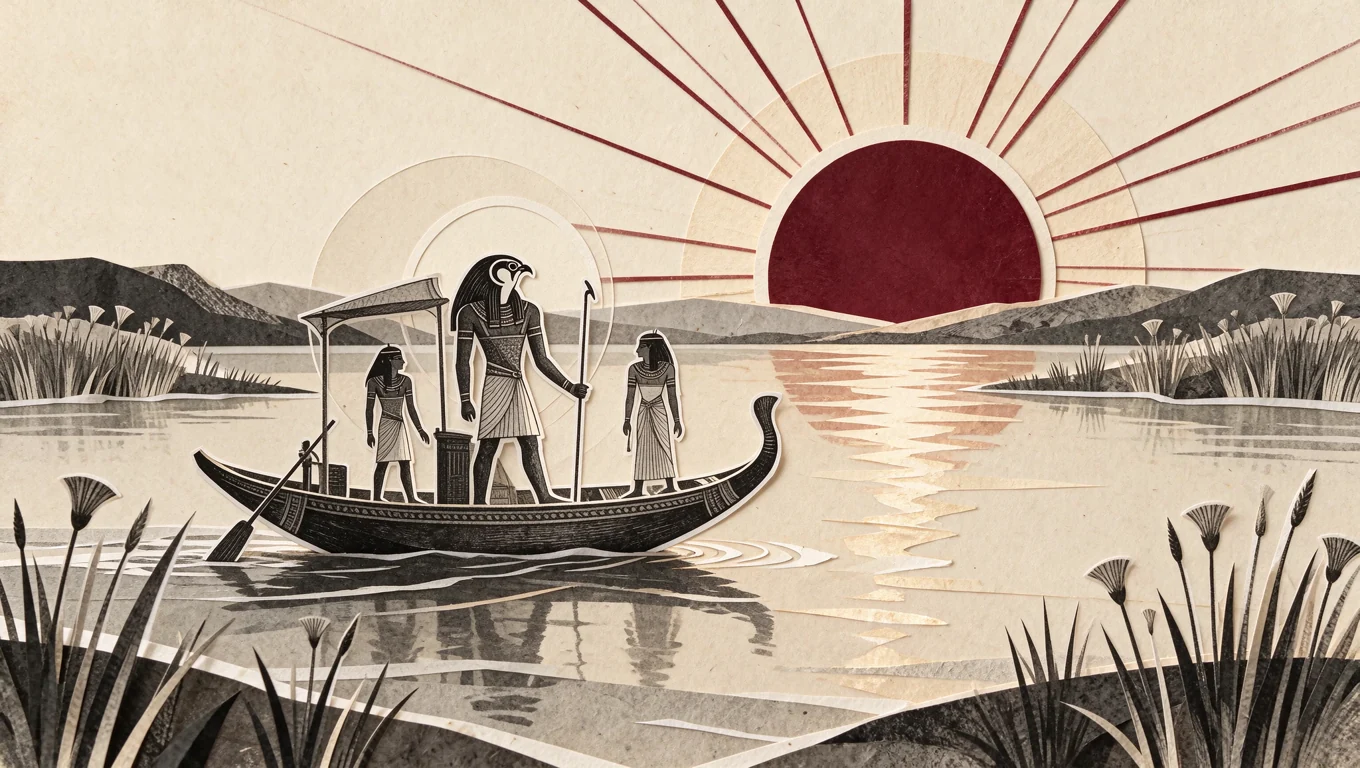
The day boat reaches the edge
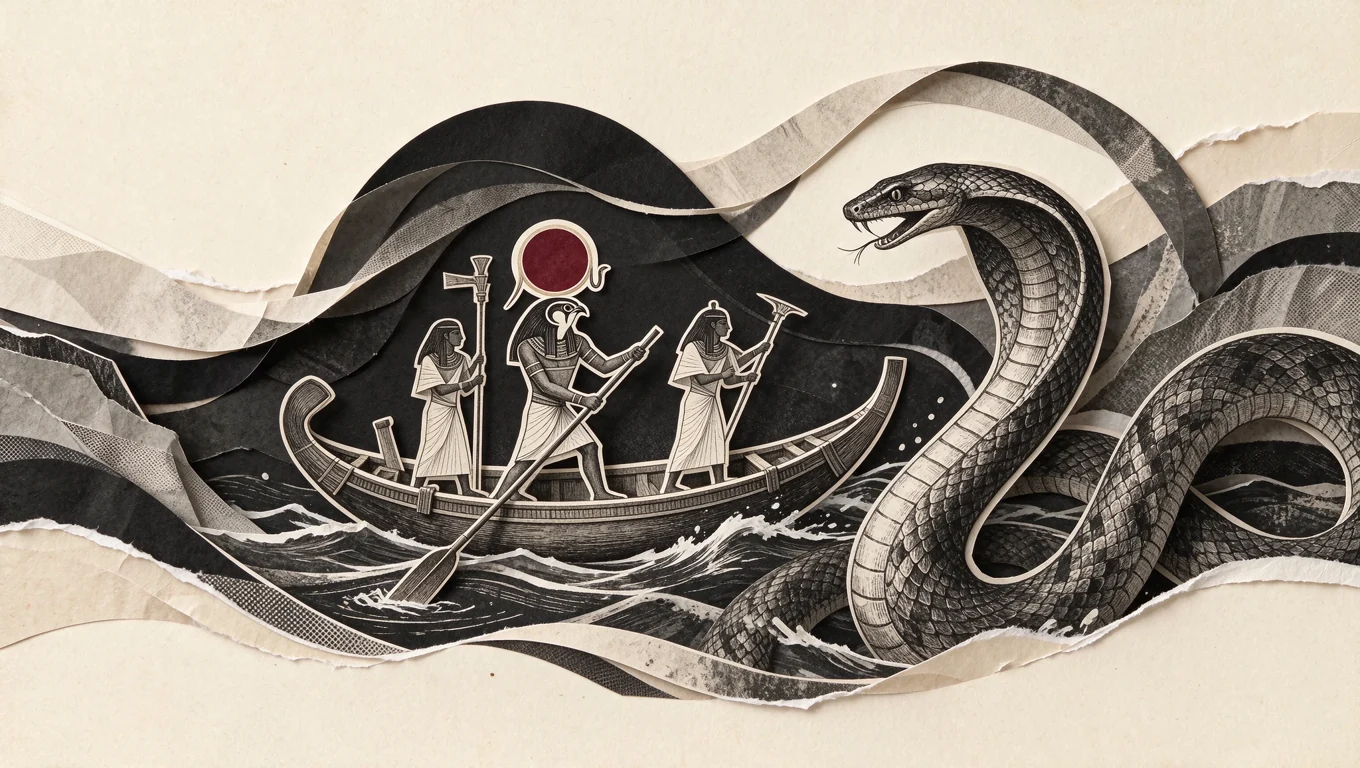
The sun crossed the sky, and the daylight began to fail. Egyptian solar traditions imagined that movement as the voyage of Ra, also written Re, in a divine boat. The crossing did not end with the visible sun. At sunset another passage began, through the world hidden from those still living above. This telling follows the broad pattern found in funerary texts and images, rather than claiming one exact route from every source. The sun that seemed so powerful overhead now entered a journey in which its return would depend upon transformation, protection and help.
The night boat carried the sun god through darkness. In some images the familiar falcon-headed figure gives way to a ram-headed form; Egyptian representations could give the same solar power different appearances at different stages. Darkness here is not simply empty space waiting for morning. It has inhabitants, regions and thresholds. On the sarcophagus of Wereshnefer, scenes from the Amduat organise the voyage through the hours of night. The object connects that passage with the dead owner’s hope of sharing renewal. The journey of the sun becomes a way to imagine life beyond its apparent ending.
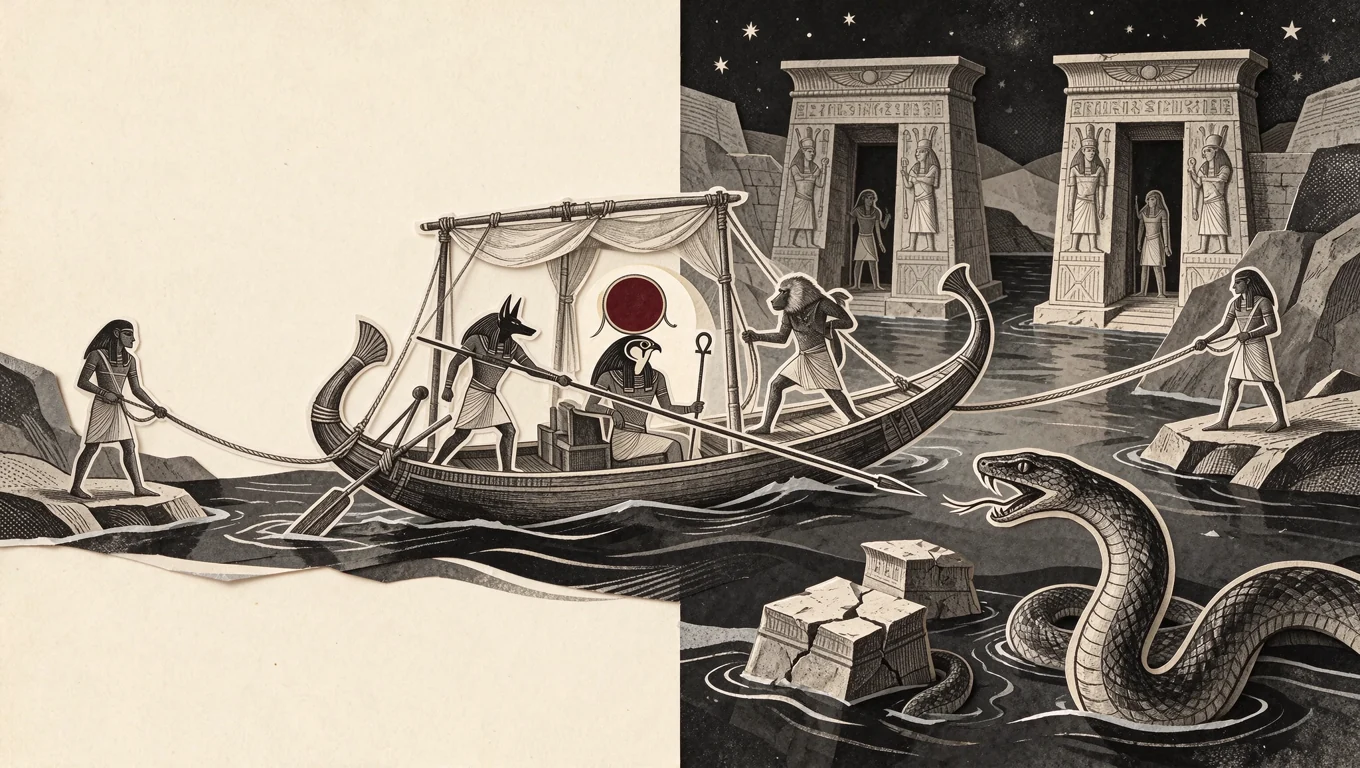
Ra did not travel alone. Divine companions protected and assisted the boat, while funerary beliefs could give the blessed dead a place in the larger cycle. Different compositions describe the company and its work differently. We do not fill this scene with a fixed crew taken from several unrelated diagrams. What matters to the shared pattern is that the solar journey requires cooperation. A god who gives light to the world can still be shown dependent upon other powers for safe passage. The boat is an image of that dependence as well as of movement.
Solar protection is shared work in these sources. Seth can act as a defender in solar contexts despite his hostility in the Osiris cycle. Roles shift between compositions; a single modern chart of wholly good and wholly evil characters can flatten that difference.
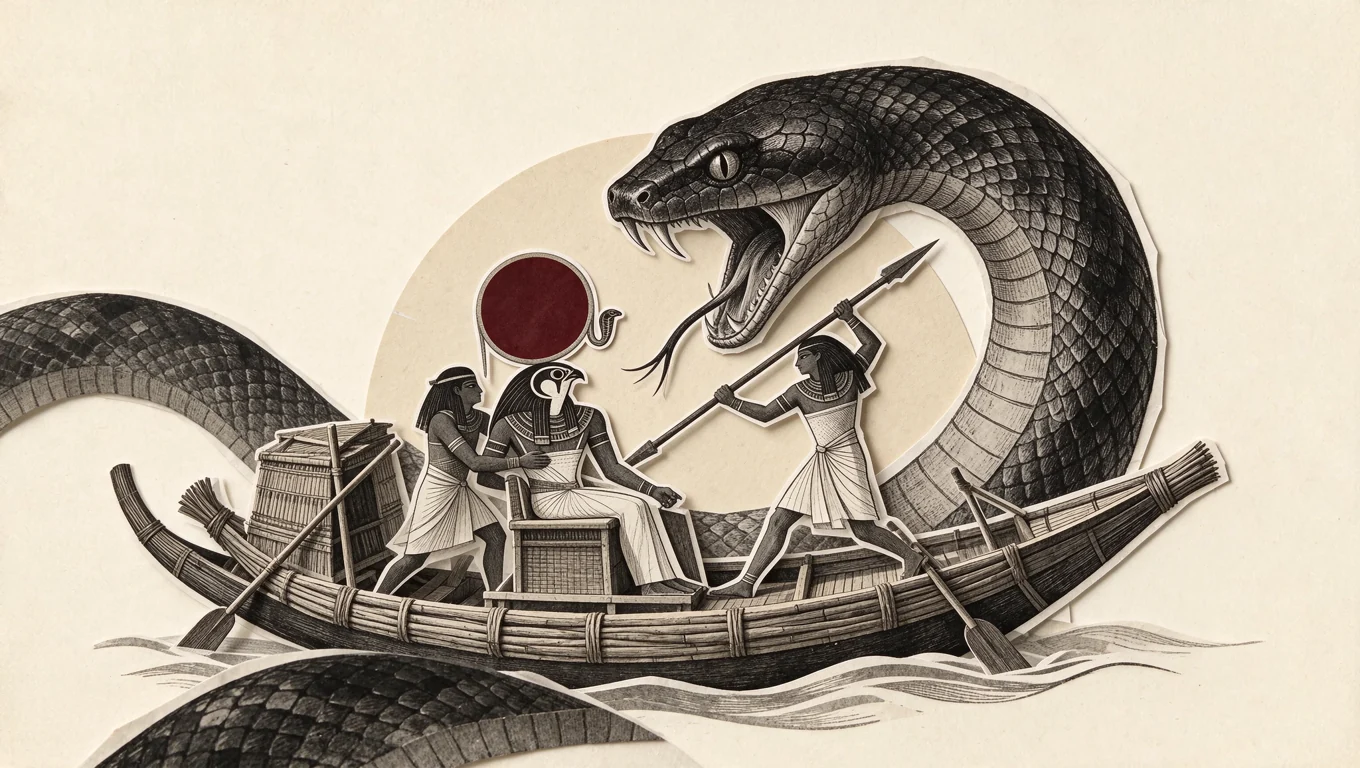
The serpent Apep, often called Apophis, threatens the passage. The danger is not merely that someone aboard might be frightened. If the sun cannot continue, the order and life sustained by its daily return are at risk. Egyptian texts and images offer several ways of representing the obstruction. The serpent may block the way or take away the water on which the boat travels. This adaptation gives the encounter a single visible focus without turning every representation into a consecutive event. The dark water and the serpent belong to a struggle whose scale extends beyond the vessel.
Ra’s helpers confront the enemy. In one Book of Gates scene, divine figures hold the great serpent in restraint so that the god can pass onward. Chains, grasping hands and spoken commands give protection a coordinated form. Other images represent the defeat differently. Here the illustration shows a confrontation beside the boat, while the telling keeps the physical violence restrained. The point is not a contest of two solitary figures with equal claims to the same throne. Apep threatens the continuing passage itself; the work of the defenders is to keep that passage possible.
Protective speech belongs to this world of action. Texts against Apophis could be recited in ritual, and hymns could celebrate and support the sun’s successful movement. For the people using them, words were not merely comments made after an event. They participated in the work of maintaining order. This page describes that belief without claiming supernatural effects for a reader’s own speech. Within the imagined night, the defenders’ actions and utterances go together. The boat can move when the forces holding back its progress have been checked.
The Amduat and the Book of Gates are related compositions, not two titles for the same itinerary. A modern sequence can draw on both if it says so. It cannot turn that choice into an exact ancient map of every night journey.
Passage through the underworld was also a renewal. In the pattern explained by the Met’s exhibition account, the sun joins with Osiris and emerges transformed, often represented as a young child or a scarab. The relationship is not a simple replacement of one god by another. The powers of the dead and of returning light meet in a cycle that can sustain both. Dawn is therefore more than the moment a traveller reaches the end of a dangerous road. The traveller is made ready to become the rising sun again, after a night in which its condition has changed.
The sun rises, and the boat belongs once more to the bright world. Water, fields and human lives can continue beneath its movement. Yet the return is not the permanent destruction of every danger. The cycle will come to sunset again, and the need for protection will be renewed. That recurrence gives the ending its particular hope. Life is not sustained by one victory safely stored in the past, but by a passage repeatedly accomplished. The illustration holds a single dawn; the story asks a reader to imagine the many dawns that follow it.
An explicit synthesis of Egyptian solar and funerary traditions, drawing on the Amduat imagery of Wereshnefer’s sarcophagus, the Met’s account of solar renewal, and a Book of Gates passage about Apep. Details vary across texts, periods and objects; no single fixed itinerary is claimed.
Several books of the underworld
The Amduat and the Book of Gates are related funerary compositions, not interchangeable chapter lists. Wereshnefer’s sarcophagus preserves a particular arrangement, while the Book of Gates passage cited here depicts Apep held in restraint. This adaptation combines their broad themes openly. It does not reproduce an official map of the Egyptian afterlife, give an exact sequence of every gate, or present the illustrations as ancient diagrams.
Apep embodies the obstruction of the solar passage. Seth can help defend Ra in solar contexts even though he is hostile in the Osiris cycle. Those roles should not be forced into a single modern division of wholly good and wholly evil characters. A reader can also notice how the night gives dependence and renewal a place within divine power. That is an interpretive invitation, not a claim that all Egyptians gave the cycle the same explanation.
The solar god, imagined in different forms along the cycle.
Apep / Apophis
The serpent who threatens the sun’s passage.
The divine companions
Helpers whose identities and tasks vary between compositions.
Osiris
The god of the dead associated with the sun’s renewal.
Reading beside this telling
Related reading for this story and its named tradition. Modern retellings and other translations are distinguished from the exact sources used above.
Egyptian Myths — Jean Menzies
For the Egyptian tradition behind this story: a modern illustrated collection. Keep the museum evidence and this later retelling distinct; this is not an ancient primary source.
For another modern approach to retelling Egyptian stories. Compare version choices rather than assuming it reproduces the exact source used on this page.
Optional purchases. Use what you already have. As an Amazon Associate I earn from qualifying purchases. Check the exact edition or model before buying.